






Table of Contents
Acme Air Equipments Navigated the 2025 US Tariff Hikes and Conquered Global Markets
The global industrial landscape was fundamentally reshaped in early 2025. What many economists predicted would be a year of steady recovery instead became a period of intense geopolitical friction as the United States implemented a series of aggressive tariff hikes on industrial machinery and equipment originating from India. These tariffs, which in some sectors soared to nearly 50%, were designed to protect domestic American manufacturing, but they inadvertently created a “stress test” for the Indian engineering sector.
For companies like Acme Air Equipments Company Pvt. Ltd., based in the thriving industrial hub of Ahmedabad, Gujarat, this was a pivotal moment. The choice was stark: scale back operations or innovate and diversify. Acme chose the latter. This article explores how the Indian industrial machinery industry – and Acme in particular – not only survived this period of economic protectionism but emerged as a more diversified, technically superior, and globally integrated force.
Understanding the 2025 Tariff Shockwaves
To understand the resilience of Acme Air Equipments, one must first understand the scale of the challenge. The 2025 US tariffs targeted goods, which included high-precision blowers, vacuum systems, and material handling equipment.
For many Indian manufacturers, the US was their primary export destination. The sudden price increase of nearly 50% meant that Indian-made products were overnight becoming more expensive for American buyers than locally sourced or European alternatives. However, the “Ahmedabad Model” of manufacturing – characterized by low overheads, high technical expertise (Technocrat-led), and rapid adaptability – provided a shield.
The Role of Technocrat Leadership
Acme Air Equipments, being a technocrat-led organization, possessed a unique advantage. Unlike purely commercial firms, Acme’s leadership understood the physics of their machines. When the tariffs hit, they didn’t just look at the balance sheets; they looked at the engineering. By refining the efficiency of products like the Turbo Blower and the Two Stage Liquid Ring Vacuum Pump, they ensured that the total cost of ownership (TCO) remained lower than competitors, even with the added tax.
The Strategic Pivot: Exploring New Frontiers
The “Survival Strategy” of 2025 was rooted in market diversification. If one door in the West was partially closed by policy, ten doors in the East and Europe were opened through strategic partnerships.
The European Renaissance
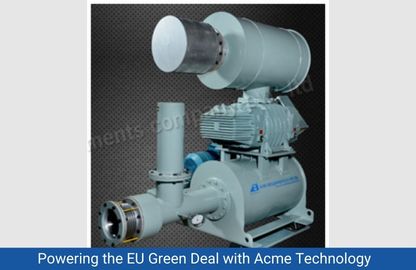
While the US turned inward, the European Union (EU) sought more reliable and cost-effective engineering partners to fuel its “Green Deal” initiatives. Acme Air Equipments capitalized on this by positioning its Tri Lobe Roots Blowers as the ideal solution for wastewater treatment and aeration.
European environmental standards are among the strictest in the world regarding noise pollution and energy consumption. Acme’s Tri Lobe technology, which reduces pulsation and mechanical noise compared to traditional Twin Lobe models, became a preferred choice for European municipal authorities. This shift from the US to the EU allowed Acme to tap into a market that valued quality over mere proximity.
The Middle Eastern Infrastructure Boom
Simultaneously, the Middle East – specifically Saudi Arabia and the UAE – was undergoing a massive infrastructure overhaul. Acme’s Cement Feeding Systems and Big Bag Unloading Systems became integral to these mega-projects. The harsh, sandy environments of the Middle East require machinery that is “over-engineered” for durability. Acme’s Ahmedabad-manufactured systems, built to withstand the rigors of the Indian climate, proved to be perfectly suited for the Arabian Peninsula.
Our Other Product
Oil Sealed Vacuum PumpProduct-Specific Resilience: A Deep Dive into the Acme Portfolio
The reason Acme Air Equipments survived where others failed was the breadth and depth of its product line. Each category of equipment offered a specific “reason to buy” that transcended tariff concerns.
Blowers and Boosters: The Breath of Industry
-
Twin Lobe and Tri Lobe Roots Blowers: These are the workhorses of the air-handling world. During the tariff hike, Acme focused on the Tri Lobe variant for export. The three-lobe design provides a smoother airflow, which translates to longer life for downstream equipment. By marketing the “life-cycle savings,” Acme convinced international buyers that an Indian blower was a smarter long-term investment.
-
Turbo Blowers: These represent the pinnacle of Acme’s R&D. In a world focused on carbon footprints, the energy efficiency of Turbo Blowers became a major selling point in the Japanese and Korean markets, further insulating Acme from US trade fluctuations.
-
Gas Boosters (Booster Compressors): As the global shift toward hydrogen and biogas intensified in 2025, Acme’s Gas Boosters became critical. These systems are designed for leak-proof handling of hazardous gases – a high-stakes application where European and Asian buyers prioritize Acme’s 30+ years of experience over the cheapest price.
The Vacuum Sector: Precision in Extremes
The pharmaceutical and chemical industries are the backbone of the global economy, and they cannot function without reliable vacuum systems.
-
Mechanical Vacuum Boosters: Acme’s boosters are often used in series with backup pumps to achieve high speeds at low pressures. During the trade war, Acme marketed these to the burgeoning chemical hubs in Southeast Asia (Vietnam, Thailand, and Indonesia).
-
Liquid Ring Vacuum Pumps (Single and Two-Stage): The Two-Stage Liquid Ring Vacuum Pump is a masterpiece of Indian engineering. It handles condensable vapors and even liquid slugs without damage. In the post-2025 landscape, Acme successfully positioned these as the primary choice for the global pharmaceutical manufacturing industry, where process uptime is the only metric that matters.
Integrated Material Handling and Safety
-
Pneumatic Conveying Systems: These systems move bulk materials through pipes using air pressure. Acme’s expertise in designing “Dense Phase” vs. “Dilute Phase” systems allowed them to win contracts in the global food processing industry, which was less affected by the 2025 tariffs than heavy industry.
-
Dust Collection Systems: With global ESG (Environmental, Social, and Governance) standards rising, Acme’s dust collection units became a mandatory addition for factories worldwide.
-
Catalyst Loading / Unloading Systems: This is a highly specialized niche. Acme’s ability to design systems that handle delicate catalysts in refineries gave them an “un-tariffable” advantage – there were simply very few global competitors who could match their technical specifications.
The “Make in India” Advantage in a Protectionist World
The 2025 tariffs were a test of the “Make in India” initiative. For Acme Air Equipments, the local ecosystem in Ahmedabad played a crucial role.
-
Supply Chain Integration: By sourcing high-grade cast iron and specialized components locally, Acme kept its production costs stable while global shipping and material costs fluctuated.
-
CNC Precision: Acme’s 16,000 sq. ft. facility is equipped with state-of-the-art CNC machinery. This ensured that every Water Ring Vacuum Pump or Roots Blower had the exact tolerances required for international certification, making it impossible for buyers to claim that Indian quality was “second-tier.”
Marketing the Resilience: How Acme Promotes Itself Internationally
In the wake of the 2025 trade shifts, Acme Air Equipments didn’t just wait for orders; they proactively built a brand of “Indestructible Engineering.”
Strategic Positioning for Europe and Beyond
Acme has rebranded its marketing efforts to emphasize:
-
Technocrat-Led Reliability: Every sales inquiry is handled by engineers, not just salesmen.
-
Customization at Scale: Unlike large Western conglomerates that offer “one-size-fits-all” products, Acme specializes in Customer Specific Applications. If a client in Germany needs a Mechanical Vacuum Booster with a specific alloy for corrosive gases, Acme can deliver it faster and more affordably than a domestic EU manufacturer.
-
Global Certifications:By adhering to ISO 9001:2015 and ensuring CE compliance for all exports, Acme has removed the “regulatory friction” that often hampers international trade.
Conclusion: The New Global Standard
The USA tariff hike of 2025 will be remembered not as the end of Indian industrial exports, but as the beginning of their global dominance. By forcing Indian companies to look beyond the North American market, the tariffs created a leaner, more innovative, and more aggressive engineering sector.
Acme Air Equipments Company Pvt. Ltd. is the embodiment of this transformation. From the streets of Ahmedabad to the industrial heartlands of Europe and the Middle East, Acme’s blowers, vacuum pumps, and conveying systems are now recognized as the gold standard. We have proven that while policies can change and tariffs can rise, true engineering excellence knows no borders.
Our Other Product
Water Ring Vacuum PumpFAQs
How did Acme keep its prices competitive despite the 2025 US tariff hikes?
We optimized our internal manufacturing processes using CNC technology and focused on high-efficiency designs like Turbo Blowers, ensuring that the energy savings for the customer outweighed any temporary tariff costs.
Which Acme products are most in demand in the European market post-FTA?
The Tri Lobe Roots Blowers and Two Stage Liquid Ring Vacuum Pumps are in high demand due to their superior noise reduction and ability to handle complex chemical vapors, meeting strict EU standards.
Does Acme provide customized solutions for the Middle Eastern infrastructure sector?
Yes, our Cement Feeding and Big Bag Unloading Systems are specifically ruggedized for high-temperature, high-dust environments, making them ideal for the rapid infrastructure growth.
What ensures the quality of Acme’s products for international buyers?
Acme is an ISO 9001:2015 certified company with a technocrat-led management team, ensuring that every product - from Gas Boosters to Dust Collection Systems - undergoes rigorous multi-stage testing.
How has Acme’s export strategy changed since the 2025 trade shifts?
We have diversified our focus to include the EU, Southeast Asia, and the Middle East, while also offering turnkey "system" solutions rather than just individual components.
About Author
CEO
Mr. Vishwesh Pardeshi is the CEO of Acme Air Equipments Company Pvt. Ltd., an industrial and engineering goods manufacturing company based in Ahmedabad, Gujarat (India). He has taken over the responsibility from founding Partners and Directors of the Company, and is now leading a talented group of professionals since 2020 by bringing in vast industrial and management expertise. By qualification, he holds a Bachelor Degree in Mechanical Engineering and also holds a MBA degree from reputed institutes. Under his leadership, the Company has successfully executed prestigious projects by delivering high quality and world class products from a state of the art manufacturing facility which combines CNC-enabled precision manufacturing and strong after sales support. In line with the Vision, Mission and Core Values of the Organization, Mr. Vishwesh Pardeshi continues to drive Quality, Reliability and Global Expansion at Acme Air Equipments Co. Pvt. Ltd.