






Table of Contents
AI-Generated Summary
This comprehensive guide examines the critical role of Liquid Ring Vacuum Pumps (LRVPs) within modern power plant infrastructures, specifically focusing on condenser exhausting and steam jet applications. By maintaining sub-atmospheric pressures, these pumps directly enhance the efficiency of the Rankine cycle, allowing turbines to extract maximum mechanical energy from steam. The article provides a deep dive into the mechanical “Roots” principle of LRVPs, their isothermal compression advantages, and their superior ability to handle saturated air and liquid carryover compared to traditional systems. Furthermore, we explore the strategic integration of LRVPs with Steam Jet Air Ejectors (SJAEs) in hybrid configurations to achieve deeper vacuum levels while minimizing motive steam consumption and operational costs.
Liquid Ring Vacuum Pumps in Power Plants
In the pursuit of peak thermal efficiency, power generation facilities rely on a delicate balance of pressure and temperature. At the heart of this balance is the surface condenser, a component whose performance is tethered to the effectiveness of the vacuum system. Liquid Ring Vacuum Pumps (LRVPs) have emerged as the industry standard for maintaining the deep vacuum necessary to maximize turbine output.
The Vital Role of Condenser Exhausting
In a steam-driven power plant, the turbine exhausts steam into a condenser where it is cooled and reverted to water. To ensure the turbine operates at its maximum potential, the exhaust pressure must be kept as low as possible—often near absolute zero.
However, air and non-condensable gases (NCGs) inevitably leak into the system through seals and joints. These gases act as an insulator on the condenser tubes, drastically reducing heat transfer efficiency and increasing backpressure on the turbine. Condenser exhausting is the process of continuously removing these gases. LRVPs are uniquely suited for this “holding” duty because they can handle the highly saturated air-vapor mixtures coming off the condenser without the risk of mechanical damage from water slugs or heavy condensation.
Working Principle: The Liquid Ring Advantage
The operational excellence of the LRVP lies in its elegant simplicity. A multi-bladed impeller is mounted eccentrically within a cylindrical casing. Before startup, the casing is partially filled with a sealing liquid, typically water.
As the impeller rotates, centrifugal force throws the liquid outward, forming a stable liquid ring against the inner wall of the casing. Because the impeller is offset, the spaces between the blades and the liquid ring vary in volume. This creates a piston-like action:
- Suction: As the volume increases, gas is drawn in from the condenser.
- Compression: As the volume decreases, the gas is compressed.
- Discharge: The compressed gas and a portion of the sealing liquid are expelled through the discharge port.
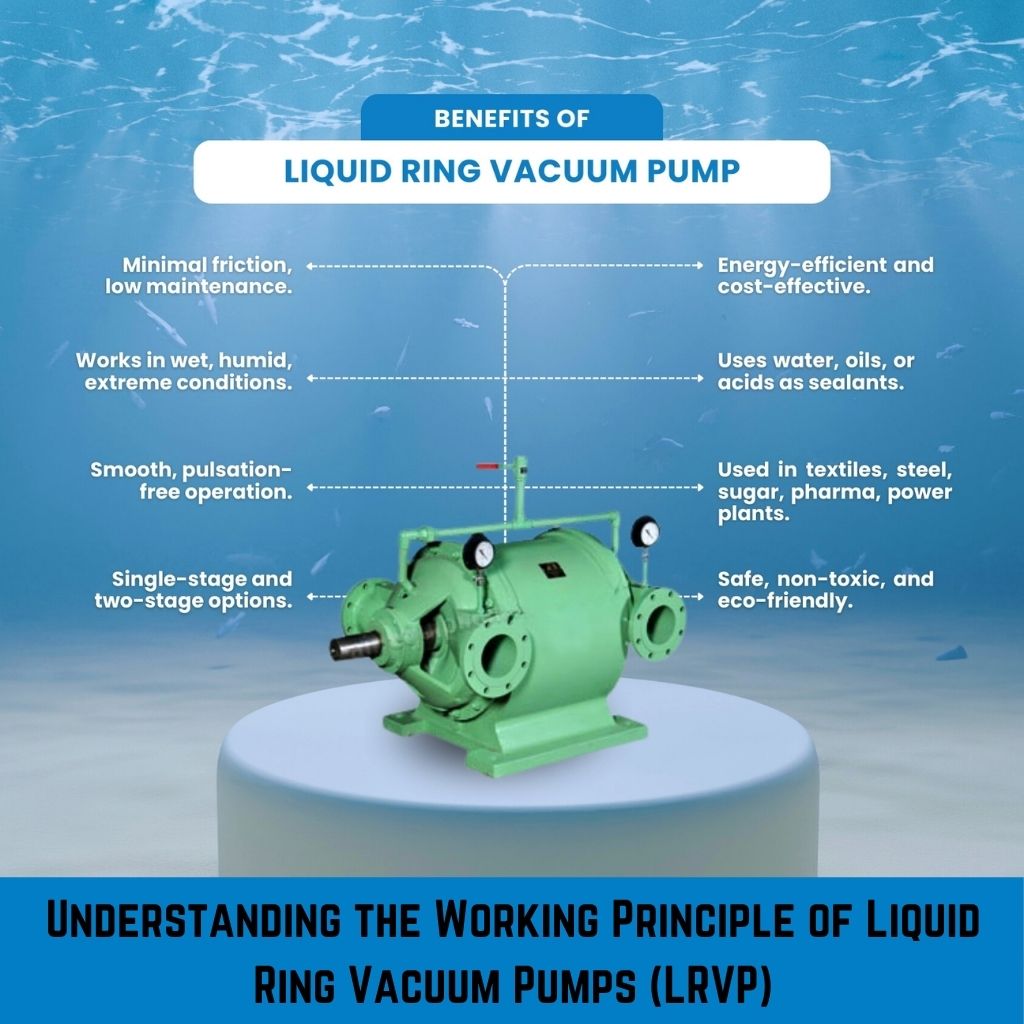
This process is inherently isothermal, meaning the heat generated during compression is immediately absorbed by the liquid ring. For power plants, this means the pump acts as a secondary “direct contact condenser,” further reducing the volume of the incoming steam and increasing the effective pumping speed.
Hogging vs. Holding: Operational Milestones
Power plant vacuum systems generally operate in two distinct modes:
- Hogging Mode: During plant startup, the vacuum system must rapidly evacuate the large volume of the condenser from atmospheric pressure down to a specific vacuum level (typically around 20” HgV). In this phase, multiple LRVP skids often run in parallel to minimize “pull-down time.”
- Holding Mode: Once the turbine is synchronized and operational, the system switches to holding mode. Here, the vacuum system handles only the air leakage and non-condensable gases. Typically, one pump is sufficient to maintain the vacuum, while the others remain in standby, ensuring 24/7 reliability.
Hybrid Systems: Integrating Steam Jet Applications
While LRVPs are exceptionally efficient at higher pressures, their capacity can drop as they approach deeper vacuum levels, especially if the sealing water temperature rises. To overcome this, many modern plants utilize Hybrid Vacuum Systems that combine Steam Jet Air Ejectors (SJAEs) with Liquid Ring Pumps.
In this configuration, a steam jet ejector acts as the first stage, using high-pressure motive steam to create a high-velocity jet that entrains the gases from the condenser. An inter-condenser then cools the mixture, condensing the motive steam and reducing the load before it enters the LRVP. This synergy allows the plant to achieve deeper vacuum levels than an LRVP could alone, while significantly reducing the total amount of motive steam required compared to a pure multi-stage ejector system.
Key Benefits for Modern Power Infrastructure
- Durability and Reliability: With only one moving part (the rotor) and no metal-to-metal contact, LRVPs boast an incredibly long service life and minimal maintenance requirements.
- Vapor Handling: Unlike “dry” mechanical pumps, LRVPs excel when handling wet gases. The liquid ring naturally condenses incoming vapors, which actually improves the pump’s volumetric efficiency.
- Environmental Safety: LRVPs use water or process-compatible liquids as a seal, eliminating the risk of oil contamination in the condensate or the plant’s exhaust stream.
- Low Vibration: The water-cushion effect of the liquid ring results in quiet, smooth operation, reducing the need for heavy structural foundations.
Frequently Asked Questions
What is the primary function of an LRVP in a power plant?
The main role of a Liquid Ring Vacuum Pump is to remove non-condensable gases and air from the steam surface condenser to maintain the lowest possible backpressure on the turbine, thereby maximizing power generation efficiency.
How does water temperature affect the performance of a liquid ring pump?
The vacuum capacity of an LRVP is directly related to the vapor pressure of its sealing liquid. If the sealing water gets too hot, its vapor pressure increases, which can limit the ultimate vacuum the pump can achieve and potentially lead to cavitation.
Can an LRVP handle liquid carryover from the condenser?
Yes. One of the greatest advantages of liquid ring technology is its ability to handle "slugs" of liquid or heavily saturated vapor without sustaining mechanical damage, as the liquid simply becomes part of the rotating ring.
What is the difference between hogging and holding?
Hogging is the rapid initial evacuation of the condenser from atmospheric pressure during startup. Holding is the continuous removal of air leaks and gases during normal turbine operation to maintain a steady vacuum.
Why are hybrid steam jet and LRVP systems used?
Hybrid systems combine the high-vacuum capability of steam ejectors with the high-efficiency and low-operating costs of LRVPs. This allows for deeper vacuums and better performance under varying load conditions.
What is cavitation in a vacuum pump?
Cavitation occurs when the pressure inside the pump drops below the vapor pressure of the sealing liquid, causing bubbles to form and then collapse violently. This can erode internal components like the impeller and casing over time.
How is cavitation prevented in power plant applications?
Cavitation is typically prevented by using a cavitation protection line that introduces a small amount of air or non-condensable gas into the pump, or by ensuring the sealing liquid is sufficiently cooled.
Does a liquid ring vacuum pump require internal lubrication?
No. Because the liquid ring acts as both the sealant and the coolant, and there is no metal-to-metal contact between the impeller and the casing, no internal oil lubrication is required in the compression chamber.
Are these pumps used in geothermal power plants?
Yes. LRVPs are highly valued in geothermal plants for their ability to handle large volumes of non-condensable gases and corrosive vapors that are often present in geothermal steam.
What are the common maintenance tasks for an LRVP?
Maintenance is minimal but generally includes checking bearing lubrication, ensuring the sealing liquid flow is consistent, and monitoring the temperature of the seal water to prevent efficiency loss.
About Author
CEO
Mr. Vishwesh Pardeshi is the CEO of Acme Air Equipments Company Pvt. Ltd., an industrial and engineering goods manufacturing company based in Ahmedabad, Gujarat (India). He has taken over the responsibility from founding Partners and Directors of the Company, and is now leading a talented group of professionals since 2020 by bringing in vast industrial and management expertise. By qualification, he holds a Bachelor Degree in Mechanical Engineering and also holds a MBA degree from reputed institutes. Under his leadership, the Company has successfully executed prestigious projects by delivering high quality and world class products from a state of the art manufacturing facility which combines CNC-enabled precision manufacturing and strong after sales support. In line with the Vision, Mission and Core Values of the Organization, Mr. Vishwesh Pardeshi continues to drive Quality, Reliability and Global Expansion at Acme Air Equipments Co. Pvt. Ltd.