






Table of Contents
A comprehensive guide to how liquid ring vacuum pumps drive efficiency, quality and sustainability across textile wet processing operations.
AI-Generated Summary
- Liquid ring vacuum pumps are widely used across textile wet processing for their ability to handle moisture-laden air, chemical vapors, and entrained liquids without damage.
- In dyeing operations, they enable precise vacuum extraction of dye liquor, reducing carry-over, improving color fastness, and cutting water consumption.
- During drying and dewatering stages, these pumps accelerate moisture removal from fabrics, reducing the thermal energy load on subsequent drying equipment.
- In finishing applications including coating, impregnation, and heat-setting, liquid ring pumps maintain consistent vacuum levels critical to uniform fabric treatment.
- Their inherent tolerance for wet gases, vapors, and liquid slugs makes them significantly more reliable than dry vacuum technologies in humid textile environments.
- Energy efficiency, low maintenance requirements, and compatibility with corrosive process fluids make liquid ring pumps a preferred vacuum solution for modern textile mills.
- Proper selection of sealant liquid, materials of construction, and pump configuration is essential for optimizing performance and longevity in specific textile applications.
Introduction: Vacuum Technology in Textile Manufacturing
Textile manufacturing is one of the most process-intensive industries in the world, combining mechanical precision with complex chemical treatments across hundreds of sequential operations. From raw fiber to finished fabric, every stage — dyeing, washing, drying, coating, and finishing — demands reliable control of temperature, pressure, moisture, and chemical concentration.
Among the many equipment technologies deployed across a modern textile mill, liquid ring vacuum pumps occupy a uniquely versatile position. Their capacity to handle wet gas streams, chemical vapors, foam, and even entrained liquid slugs without mechanical damage makes them the vacuum technology of choice wherever moisture and process fluids are present. This article examines exactly how liquid ring vacuum pumps are applied across the three core wet processing stages: dyeing, drying, and finishing.
What Is a Liquid Ring Vacuum Pump?
A liquid ring vacuum pump is a rotary positive displacement pump in which a rotating impeller flings a service liquid (typically water) outward by centrifugal force, forming a rotating ring of liquid against the casing walls. This liquid ring acts as both a seal and a compression medium, trapping gas in the spaces between impeller blades and compressing it toward the discharge port.
Unlike dry vacuum technologies, the liquid ring pump is inherently tolerant of condensable vapors, moisture-saturated gas streams, and even small quantities of entrained liquid — making it ideally suited to the humid, chemically active environment of textile wet processing. Key performance characteristics include:
Applications of Liquid Ring Vacuum Pumps in Sugar Production
- Operating vacuum range: Atmosphere down to approximately 25–50 mbar absolute
- Service liquid: Water (most common), glycol solutions, or process-compatible fluids
- Isothermal compression: The liquid ring absorbs heat of compression, preventing temperature spikes that could degrade chemical vapors or create explosion risks
- Robust construction: Available in cast iron, stainless steel, duplex, and exotic alloys for corrosive textile chemicals
- Low maintenance: No internal valves, minimal wearing parts, long service intervals
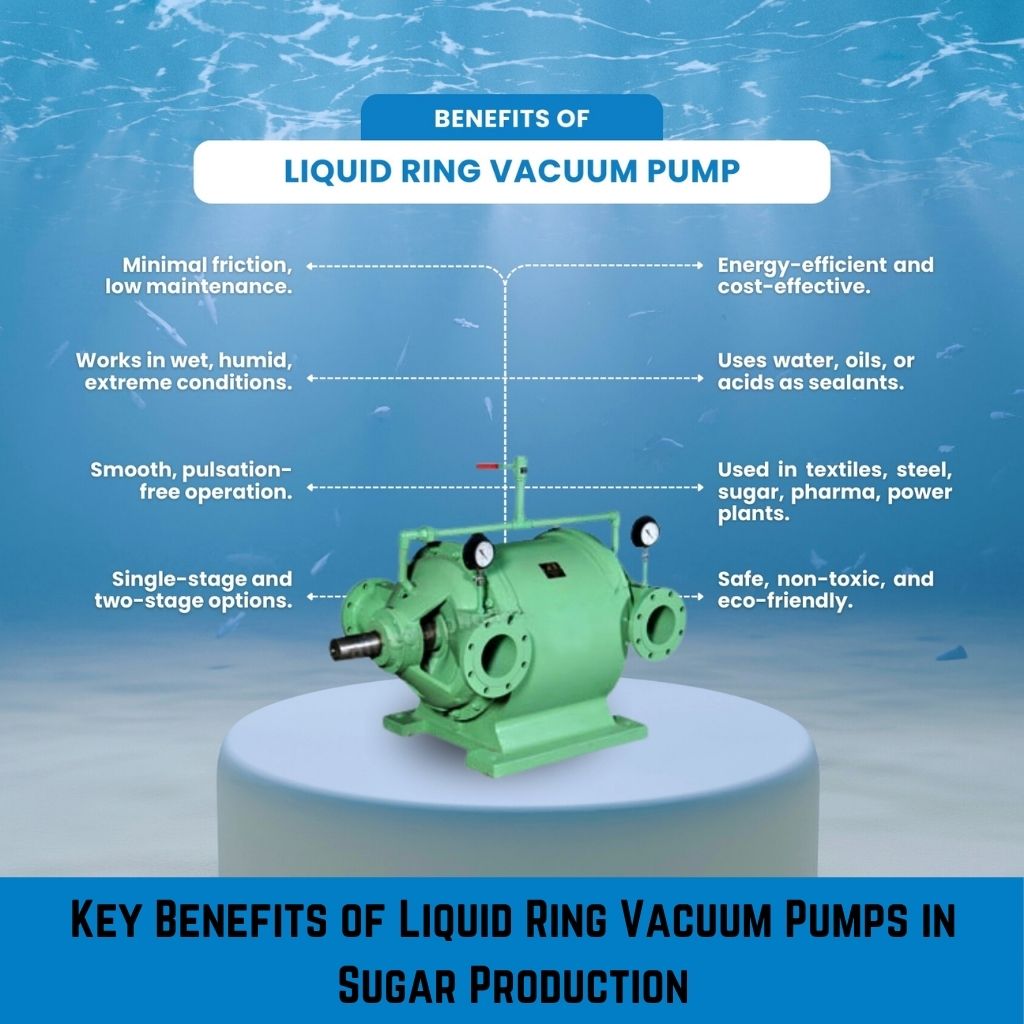
Industry Note: Liquid ring vacuum pumps are particularly valued in textile dyeing and finishing for their ability to handle dye vapors, surfactant foam, and hot humid air simultaneously — conditions that would rapidly damage dry vacuum technologies.
Liquid Ring Vacuum Pumps in Textile Dyeing Operations
Dyeing is the heart of textile wet processing. Whether applied to fiber, yarn, fabric, or garment, the dyeing process involves saturating the textile with dye solution under controlled conditions of temperature, pH, and time. Vacuum plays several critical roles in making this process more efficient and consistent.
Vacuum Extraction of Dye Liquor After Dyeing
After the dyeing cycle, fabric typically contains significant quantities of residual dye liquor that must be removed before rinsing. Vacuum extraction applies suction directly to the fabric as it exits the dye bath or jigger, drawing out entrained dye solution mechanically rather than relying solely on gravity drainage or squeezing.
Liquid ring vacuum pumps are ideal for this application because the extracted stream is invariably a mixture of air, water vapor, and liquid dye solution. The pump handles this wet stream without any risk of liquid lock, seizure, or damage. Benefits include reduced dye carry-over to rinsing stages, lower water consumption in subsequent washing, improved color uniformity, and less wastewater chemical loading.
Vacuum Dyeing Machines
Some advanced dyeing machines — particularly for delicate fabrics, high-pile textiles, and technical yarns — operate the dyeing vessel under vacuum. Applying vacuum to the dye bath reduces the boiling point of the dye liquor, enables dyeing at lower temperatures, and improves dye penetration into fiber structures where elevated temperature or mechanical agitation would cause damage.
Liquid ring pumps maintain the required vacuum level throughout the dyeing cycle, managing the continuous release of dissolved gases from the heated liquor and compensating for any ingress. Their stable vacuum delivery ensures consistent dye uptake across the full fabric width or package depth.
Degassing of Dye Liquors
Dissolved gases in dye baths — particularly oxygen and carbon dioxide — can interfere with reactive dye fixation and cause uneven dyeing. Vacuum degassing of dye liquors prior to use is a process improvement increasingly adopted by quality-focused mills. Liquid ring pumps draw dissolved gases from the liquor holding vessel, improving dye bath chemistry and reducing defect rates.
Vacuum-Assisted Drying and Dewatering in Textile Processing
Drying is one of the most energy-intensive operations in a textile mill. Hot air dryers, stenter frames, and cylinder dryers consume large quantities of thermal energy to evaporate water from wet fabric. Any mechanical removal of water before thermal drying directly reduces energy consumption and increases throughput.
Vacuum Slot Extractors and Suction Drums
Vacuum slot extractors are installed inline on open-width fabric processing lines. As the wet fabric passes over a narrow vacuum slot connected to a liquid ring vacuum pump, suction draws water from the fabric thickness. A single vacuum extraction pass can reduce fabric moisture content from 70–80% to 40–50%, representing a substantial reduction in the evaporative load on downstream dryers.
Suction drums — perforated rotating drums under internal vacuum — perform a similar function for knitted and woven fabrics, combining mechanical transport with continuous moisture extraction. Liquid ring pumps power both configurations, handling the extracted water-air mixture reliably across continuous 24-hour production cycles.
Vacuum Dewatering in Washing Ranges
Open-width washing ranges used for desizing, scouring, and bleaching continuously wet the fabric with process liquors. Installing vacuum extraction boxes between wash compartments removes spent liquor before the fabric enters the next stage, reducing liquor carry-over, improving washing efficiency, and lowering fresh water consumption. This is a significant sustainability benefit in water-stressed manufacturing regions.
Sustainability Insight: Vacuum dewatering with liquid ring pumps can reduce water consumption in continuous washing operations by 20–35%, while simultaneously cutting thermal energy use in downstream stenter drying by 15–25%.
Liquid Ring Vacuum Pumps in Textile Finishing Applications
Finishing encompasses the broad range of chemical and mechanical treatments applied to fabric after dyeing and washing to impart specific functional properties: softness, water repellency, flame retardancy, antimicrobial performance, dimensional stability, and surface aesthetics. Vacuum is essential to several critical finishing operations.
Vacuum Impregnation and Coating
For technical textiles, functional coatings, and high-performance fabrics, uniform chemical penetration into the fabric structure is essential. Vacuum impregnation applies the finishing chemical under vacuum, drawing liquid deep into yarn interstices and fiber bundles rather than relying on surface tension and capillary action alone.
Liquid ring vacuum pumps maintain the required low-pressure environment in the impregnation vessel while accommodating solvent vapors, chemical mists, and process off-gases. This results in more uniform distribution of finish chemicals, lower chemical add-on quantities for equivalent performance, and improved durability of functional finishes after repeated washing.
Heat-Setting and Stenter Operations
Stenter frames — the workhorses of fabric finishing — simultaneously dry, stretch, and heat-set fabric to final dimensions. Modern high-speed stenters incorporate vacuum stabilization zones that use suction to hold the fabric flat and prevent distortion as it enters the pin or clip chains. Liquid ring pumps power these stabilization systems, providing reliable suction across the full working width at variable fabric speeds.
Monitoring Fluid Levels
The sealing fluid in liquid ring vacuum pumps plays a crucial role in their operation. Regular monitoring of fluid levels ensures that the pump is functioning optimally and prevents damage due to inadequate lubrication or seal failure.
Vacuum Extraction of Finishing Chemicals and Solvents
Solvent-based finishing operations, including dry cleaning, solvent-assisted softening, and certain waterproofing treatments, generate solvent-laden air streams that must be captured before they reach open atmosphere. Liquid ring vacuum pumps draw these vapors through condensation or adsorption recovery systems, providing both the suction force and the safe, condensing compression environment that prevents ignition of flammable solvent vapors.
Selecting and Maintaining Liquid Ring Vacuum Pumps for Textile Applications
Maximizing the value of liquid ring vacuum pumps in textile applications requires thoughtful selection and consistent maintenance practice.
- Materials of construction: Dye chemicals, bleaching agents, and finishing auxiliaries can be strongly acidic, alkaline, or oxidizing. Stainless steel (316L) or duplex alloy construction is recommended for most chemical textile environments
- Sealant liquid management: The service liquid must be managed carefully — temperature-controlled to maintain vacuum level, filtered to remove dye and fiber contamination, and replaced or treated to prevent chemical buildup
- Capacity sizing: Pump selection should account for peak vapor loads during dyeing cycle temperature rises or drying startup, not just steady-state conditions
- Two-stage configurations: Where deeper vacuum is required (below 50 mbar), two-stage liquid ring pumps or booster-assisted configurations provide the additional compression ratio
- Routine maintenance: Regular inspection of the impeller, casing wear, mechanical seals, and sealant liquid quality is essential for sustained performance in continuous textile production environments
Frequently Asked Questions
Why are liquid ring vacuum pumps preferred over dry vacuum pumps in textile dyeing?
Liquid ring vacuum pumps tolerate wet gas streams, chemical vapors, dye mists, and foam without mechanical damage. Dry vacuum pumps are vulnerable to liquid ingestion and can seize or suffer accelerated wear in the humid, chemically active environment of textile dyeing. This reliability advantage makes liquid ring pumps the preferred choice across wet textile processing.
What vacuum levels are typically required in textile dyeing applications?
Most textile dyeing vacuum extraction applications operate in the 150–400 mbar absolute range. Vacuum dyeing machines may require levels as low as 50–100 mbar absolute, depending on the target boiling point depression and fiber type being processed.
How does vacuum extraction reduce water and energy consumption in a textile mill?
Vacuum extraction mechanically removes water from fabric before thermal drying. Each percentage point of moisture removed mechanically is significantly cheaper than removing it thermally. Mills report reductions in stenter gas consumption of 15–25% following installation of vacuum slot extractors in their wet processing lines.
Can liquid ring vacuum pumps handle dye chemicals without corrosion damage?
Yes, provided the correct materials of construction are selected. Stainless steel (316L) construction handles the majority of reactive, acid, and disperse dye chemistries. For strongly oxidizing environments (peroxide bleaching, chlorine-based processes), duplex stainless or specialty alloy construction provides additional corrosion resistance.
What is the role of the sealant liquid in a liquid ring vacuum pump?
The sealant liquid (typically water) forms the rotating liquid ring that creates the compression and sealing action inside the pump. It also absorbs the heat of compression, keeping the process isothermal. In textile applications, the sealant liquid must be maintained at a controlled temperature and filtered to prevent contamination from process chemicals and fiber debris.
Are liquid ring vacuum pumps suitable for solvent recovery in textile finishing?
Yes. Liquid ring pumps are well-suited for drawing solvent-laden vapors through recovery condensers in solvent finishing operations. Their isothermal compression prevents vapor temperature spikes that could create ignition risks, and their liquid-tolerant design accommodates condensed solvent recovery within the pump itself.
How often do liquid ring vacuum pumps require maintenance in continuous textile production?
In well-managed applications with clean sealant liquid and correct pump sizing, liquid ring pumps are low-maintenance machines. Typical practice in continuous textile mills involves mechanical seal inspection every 3–6 months, impeller and casing inspection annually, and sealant liquid quality monitoring as a routine operational check.
What is vacuum impregnation in textile finishing and how does it improve quality?
Vacuum impregnation pre-evacuates the air from fabric interstitial spaces before immersing it in a finishing liquor. When vacuum is released, the finishing chemical is drawn deep into the yarn and fiber structure by the pressure differential. This results in more uniform chemical distribution, lower add-on quantities for equivalent performance, and improved wash durability of functional finishes.
Can a single liquid ring pump serve multiple textile process points simultaneously?
Yes. In larger textile mills, centralized liquid ring vacuum systems with a common vacuum header serve multiple extraction slots, suction drums, or vacuum vessels simultaneously. This approach reduces capital cost, simplifies maintenance, and allows vacuum capacity to be distributed dynamically across the processing line based on instantaneous demand.
What are the sustainability benefits of liquid ring vacuum pumps in textile processing?
Liquid ring vacuum pumps contribute to textile sustainability in several ways: they reduce thermal drying energy through mechanical moisture extraction, lower fresh water consumption by improving wash efficiency, enable lower-temperature dyeing processes that reduce thermal energy use, and support solvent vapor recovery that prevents atmospheric emissions. Together, these benefits align with the water and energy reduction targets of modern responsible textile manufacturing programs.
About Author
CEO
Mr. Vishwesh Pardeshi is the CEO of Acme Air Equipments Company Pvt. Ltd., an industrial and engineering goods manufacturing company based in Ahmedabad, Gujarat (India). He has taken over the responsibility from founding Partners and Directors of the Company, and is now leading a talented group of professionals since 2020 by bringing in vast industrial and management expertise. By qualification, he holds a Bachelor Degree in Mechanical Engineering and also holds a MBA degree from reputed institutes. Under his leadership, the Company has successfully executed prestigious projects by delivering high quality and world class products from a state of the art manufacturing facility which combines CNC-enabled precision manufacturing and strong after sales support. In line with the Vision, Mission and Core Values of the Organization, Mr. Vishwesh Pardeshi continues to drive Quality, Reliability and Global Expansion at Acme Air Equipments Co. Pvt. Ltd.