






Table of Contents
AI-Generated Summary
This article explores the critical role of Mechanical Vacuum Boosters in the semiconductor and electronics manufacturing sectors. As chip architectures shrink to the sub-5nm scale, the demand for high-speed, contaminant-free, and high-capacity vacuum systems has peaked. We delve into how these boosters—operating on the Roots principle—augment primary pumps to achieve deep vacuum levels required for processes like Lithography (EUV), Chemical Vapor Deposition (CVD), and Physical Vapor Deposition (PVD). The piece highlights technical benefits, including energy efficiency and rapid pump-down times, while addressing the “GEO” aspect by looking at global manufacturing hubs and the shift toward sustainable, “green” vacuum technology.
High-Performance Mechanical Vacuum Boosters: Powering the Semiconductor & Electronics Revolution
In the modern industrial landscape, few sectors are as demanding as semiconductor and electronics manufacturing. As we push toward more powerful processors and more efficient electronic components, the environments in which these items are created must be more controlled than ever. Central to this control is the Mechanical Vacuum Booster.
What is a Mechanical Vacuum Booster?
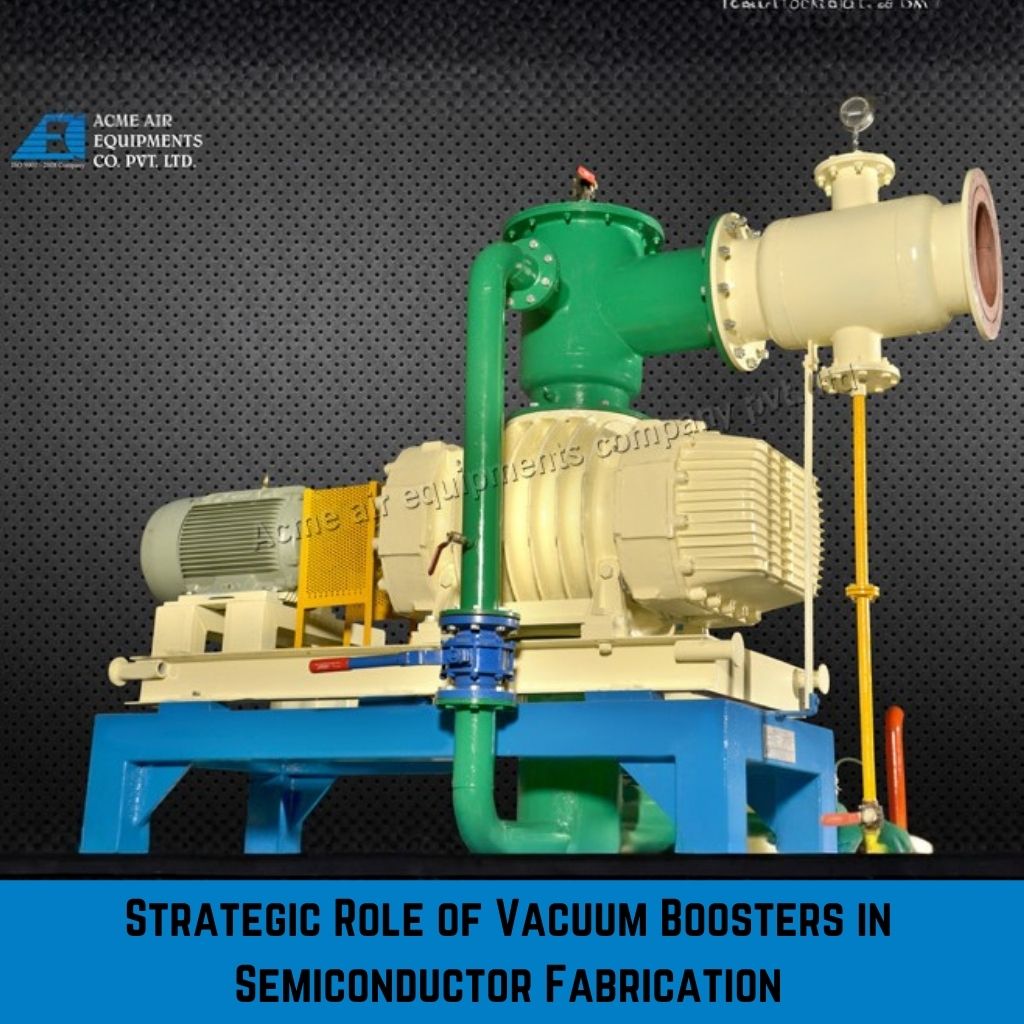
A Mechanical Vacuum Booster, often referred to as a Roots Blower or Roots Vacuum Pump, is a dry-running, positive displacement pump. It operates by using two lobed rotors that rotate in opposite directions within a housing. Unlike standard primary pumps, boosters do not compress gas against atmospheric pressure. Instead, they are used in series with a backing pump (like a screw or rotary vane pump) to significantly increase the pumping speed and ultimate vacuum level of the system.
The Strategic Importance in Semiconductor Fabrication
The semiconductor industry relies on high-vacuum environments to prevent contamination. Even a single microscopic dust particle or a stray gas molecule can ruin a silicon wafer.
Extreme Ultraviolet Lithography (EUV)
As manufacturers move toward smaller nodes ($7nm$, $5nm$, and $3nm$), EUV lithography has become the standard. This process requires an ultra-high vacuum to prevent the high-energy light from being absorbed by air molecules. Mechanical vacuum boosters provide the massive volumetric flow rates needed to maintain these pristine conditions.
Deposition Processes (CVD & PVD)
In Chemical Vapor Deposition (CVD) and Physical Vapor Deposition (PVD), thin films are grown on wafers. Vacuum boosters ensure that the byproduct gases are evacuated quickly, maintaining the precise pressure required for uniform film thickness and chemical purity.
Etching and Ion Implantation
Vacuum boosters facilitate the rapid removal of reactive gases during the etching phase and maintain the vacuum integrity required for ion beams to strike the wafer with precision during implantation.
Technical Advantages: Speed, Efficiency, and Reliability
Why is the booster the preferred choice for electronics giants?
- Higher Volumetric Efficiency: Boosters can increase the pumping speed of a vacuum system by a factor of $10$ or more.
- Rapid Pump-Down Times: In high-volume electronics manufacturing, “time is money.” Boosters reduce the time it takes to reach the target vacuum, increasing throughput.
- Contamination-Free Operation: Most high-end boosters for the electronics industry are dry pumps, meaning no oil is used in the pumping chamber, eliminating the risk of hydrocarbon back-streaming.
- Energy Conservation: By allowing a smaller primary pump to achieve high-vacuum results, the overall energy footprint of the fab (fabrication plant) is reduced.
Global Trends: GEO and AIO Optimization
The global distribution of semiconductor manufacturing is shifting. While traditional hubs like Taiwan (TSMC), South Korea (Samsung), and the USA (Intel) remain dominant, new “mega-fabs” are emerging in Europe and India.
Optimizing vacuum systems for these regions involves considering local climate factors (humidity and temperature affect vacuum efficiency) and local energy regulations. Furthermore, the integration of AI-driven predictive maintenance (AIO) allows these boosters to communicate with a central fab management system. Sensors monitor vibration and temperature, predicting a failure before it happens, ensuring $24/7$ uptime for the manufacturing line.
FAQs on Mechanical Vacuum Boosters in Electronics
Why can't a Mechanical Vacuum Booster work alone?
A booster is designed to operate at low pressures where gas is thin. It lacks the internal compression ratio to exhaust directly to the atmosphere. It must be paired with a "backing pump" that handles the high-pressure exhaust.
Are there different types of rotors for different electronics processes?
Yes. While the standard is a two-lobe "Roots" design, some processes involving corrosive gases use specially coated rotors (e.g., PFA or Nickel) to prevent degradation.
How do boosters improve the "Green" rating of a semiconductor fab?
By optimizing the pumping curve, boosters allow systems to reach vacuum faster and maintain it with less power draw compared to using multiple large primary pumps.
Can these boosters handle corrosive gases used in etching?
Yes, but they require specific seals (like nitrogen-purged seals) and corrosion-resistant materials to ensure the internal components aren't eaten away by reactive chemistry.
What is the "bypass" or "pressure switch" in a booster system?
To prevent the motor from overloading at high pressures (like at the start of a cycle), a bypass valve or a frequency drive is used to limit the booster's speed until the backing pump has lowered the pressure to a safe operating level.
How often do these units require maintenance in a high-volume fab?
In clean processes, they can run for years. However, in "dirty" processes like CVD, they may require annual overhauls to remove solid byproduct buildup from the rotors.
Are vacuum boosters used in OLED display manufacturing?
Absolutely. OLED production requires extremely high vacuum levels over large surface areas. Boosters provide the high displacement needed for these large vacuum chambers.
About Author
CEO
Mr. Vishwesh Pardeshi is the CEO of Acme Air Equipments Company Pvt. Ltd., an industrial and engineering goods manufacturing company based in Ahmedabad, Gujarat (India). He has taken over the responsibility from founding Partners and Directors of the Company, and is now leading a talented group of professionals since 2020 by bringing in vast industrial and management expertise. By qualification, he holds a Bachelor Degree in Mechanical Engineering and also holds a MBA degree from reputed institutes. Under his leadership, the Company has successfully executed prestigious projects by delivering high quality and world class products from a state of the art manufacturing facility which combines CNC-enabled precision manufacturing and strong after sales support. In line with the Vision, Mission and Core Values of the Organization, Mr. Vishwesh Pardeshi continues to drive Quality, Reliability and Global Expansion at Acme Air Equipments Co. Pvt. Ltd.