






Table of Contents
How vacuum booster pumps enhance freeze drying efficiency, reduce cycle times, and lower energy consumption in pharmaceutical and food lyophilization.
What Is Freeze Drying (Lyophilization) and Why Does Vacuum Matter?
Freeze drying, scientifically known as lyophilization, is a dehydration process that preserves temperature-sensitive materials — from life-saving vaccines and biologics to specialty foods and nutraceuticals. The process works by first freezing the product, then reducing the surrounding pressure to allow frozen water (ice) to sublimate directly from solid to vapor, bypassing the liquid phase entirely.
The vacuum system is the backbone of every lyophilization cycle. Without achieving and maintaining deep vacuum levels — typically in the range of 0.1 to 1.0 mbar — sublimation cannot proceed efficiently, product quality suffers, and cycle times stretch unnecessarily. This is precisely where mechanical vacuum boosters become indispensable.
Key Insight: The vacuum system directly determines the speed, efficiency, and quality of every freeze drying cycle. Upgrading to a mechanical vacuum booster can cut primary drying time by 20–40% in pharmaceutical lyophilization applications.
What Is a Mechanical Vacuum Booster?
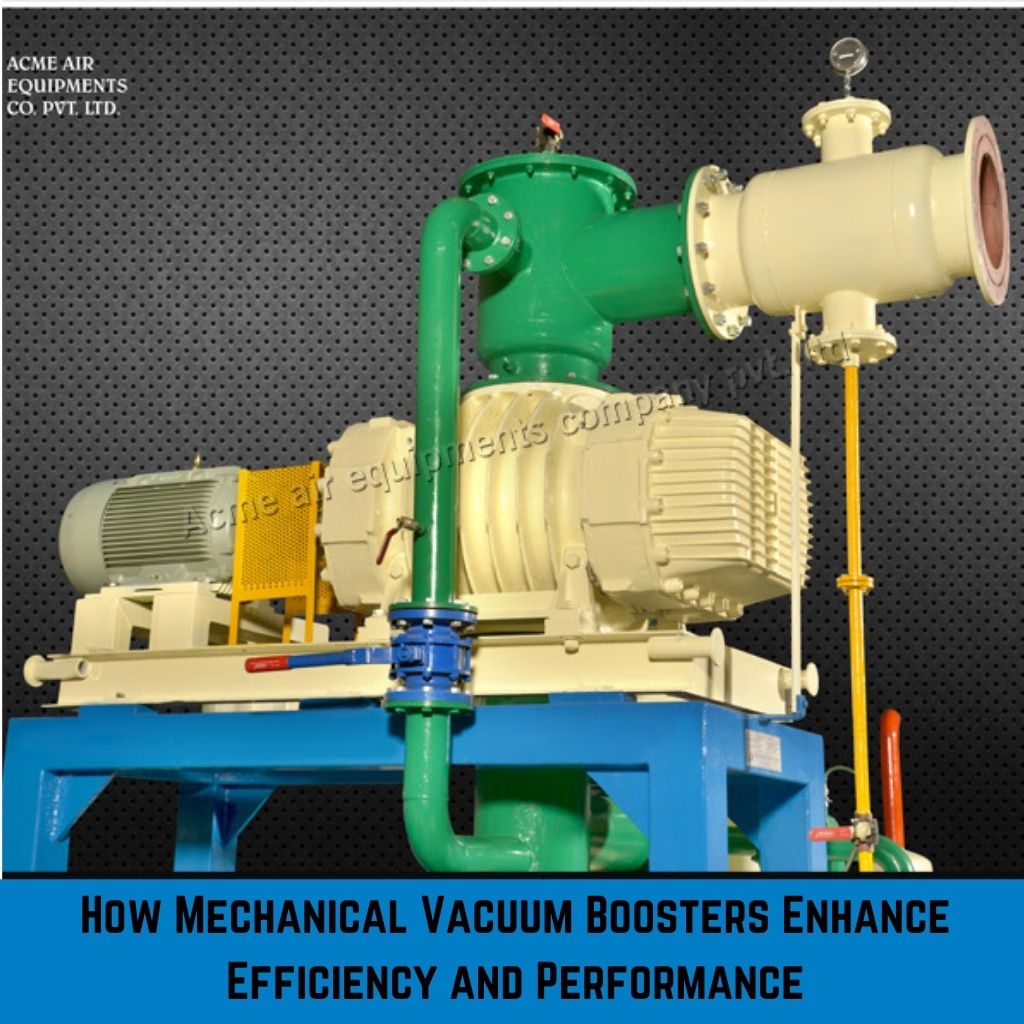
A mechanical vacuum booster — also called a Roots vacuum pump or Roots blower — is a positive displacement pump that amplifies the pumping speed of a backing pump (such as a rotary vane, dry screw, or liquid ring pump) without compressing gas internally. It uses two counter-rotating figure-eight-shaped rotors that do not contact each other or the pump casing, enabling oil-free, high-speed gas displacement.
How Mechanical Vacuum Boosters Work
The operating principle relies on volumetric displacement. Gas enters the inlet, is trapped between the lobes and the casing, and is transferred to the outlet side where the backing pump evacuates it. The booster multiplies the effective pumping speed of the system — allowing the combined pump set to reach lower pressures faster and more efficiently than the backing pump alone. Key operating characteristics include:
- Pressure range: Typically effective between 0.1 mbar and 100 mbar — the exact range needed in lyophilization primary drying
- Pumping speed multiplication: Boosters increase system pumping speed by 5x to 10x over the backing pump alone
- Oil-free gas path: No process contamination risk — critical for pharmaceutical GMP compliance
- Low power-to-throughput ratio: More gas moved per kilowatt of energy consumed
The Three Stages of Lyophilization and Vacuum Requirements
Understanding vacuum booster integration requires mapping each freeze drying stage to its specific vacuum demand.
Stage 1: Freezing
The product is cooled below its eutectic or glass transition temperature. No vacuum is required at this stage, but the vacuum system must be ready for rapid pump-down when freezing is complete.
Stage 2: Primary Drying (Sublimation)
This is the most time-intensive phase, consuming 60–80% of total cycle time. Chamber pressure is reduced to the target setpoint (commonly 0.1–0.3 mbar for pharmaceuticals) and shelf temperature is raised to supply sublimation energy. The vacuum system must handle peak water vapor loads continuously. This is where mechanical vacuum boosters deliver maximum value — providing the high pumping speed needed to remove large volumes of water vapor rapidly, preventing chamber pressure from rising above setpoint and stalling sublimation.
Stage 3: Secondary Drying (Desorption)
Residual bound moisture is removed by raising shelf temperatures further while maintaining deep vacuum (often below 0.05 mbar). The booster plus backing pump combination must achieve and sustain ultra-low pressures to drive desorption to completion — essential for achieving final moisture content specifications below 1% in most pharmaceutical products.
Critical Fact: Pharmaceutical lyophilization typically requires chamber pressures between 0.1 mbar and 0.3 mbar during primary drying. Mechanical vacuum boosters are specifically engineered to operate at peak efficiency in exactly this pressure range.
Key Benefits of Mechanical Vacuum Boosters in Freeze Drying
Dramatically Increased Pumping Speed
The most quantifiable benefit is the increase in volumetric pumping speed. A backing pump operating alone may deliver 200–500 m³/h at typical lyophilization pressures. Adding a mechanical booster upstream can push effective system pumping speed to 1,000–5,000 m³/h, enabling faster pressure reduction and higher water vapor throughput throughout primary drying.
Reduced Cycle Time and Increased Productivity
Faster evacuation of water vapor directly translates to shorter primary drying times. For pharmaceutical manufacturers running lyophilizers around the clock, a 20–30% reduction in cycle time represents significant increases in batch throughput and revenue per equipment asset — without any capital investment in additional freeze dryers.
Lower Energy Consumption
Mechanical boosters move more gas with less energy than scaling up backing pump capacity alone. Running a smaller backing pump plus a booster consumes significantly less power than operating multiple large backing pumps to achieve equivalent throughput. This matters enormously in large-scale GMP facilities where lyophilization is a continuous, energy-intensive operation.
Improved Ultimate Vacuum
Boosters help systems achieve lower ultimate pressures, which is critical during secondary drying. Deeper vacuum accelerates desorption of bound water, reducing secondary drying time and improving final product moisture content — a key quality attribute for biologics, mRNA vaccines, and protein-based therapeutics.
Protection of the Backing Pump
In solvent-containing lyophilization applications, the booster acts as a buffer, reducing solvent vapor concentration reaching the backing pump. This extends backing pump service life, reduces maintenance frequency, and lowers contamination risks.
Selecting the Right Vacuum Booster for Lyophilization
Selecting the appropriate unit for a freeze drying application requires evaluating several parameters:
- Compression ratio: Match the booster’s compression ratio to the expected pressure differential in the system
- Pumping speed at working pressure: Evaluate performance curves specifically at the 0.1–1.0 mbar operating range
- Temperature management: Integrated cooling (water or air) prevents overheating during continuous operation
- Material compatibility: Pharmaceutical applications require stainless steel housings, FDA-compliant seals, and validated cleaning procedures
- Control integration: Modern boosters support variable frequency drives (VFDs) and PLC integration for automated pressure profiling
- ATEX/explosion-proof ratings: Required when processing flammable solvents or in hazardous area classifications
Mechanical Vacuum Boosters vs. Alternative Vacuum Technologies
When evaluating vacuum systems for freeze dryers, engineers compare several technologies. Mechanical vacuum boosters paired with a backing pump outperform standalone alternatives in the critical primary drying pressure range. Liquid ring pumps struggle to reach pressures below 10 mbar without vapor condensation issues. Dry screw pumps alone offer good ultimate pressure but limited pumping speed at intermediate pressures. Turbomolecular pumps excel at ultra-high vacuum but are impractical for the high water vapor loads of freeze drying primary drying cycles.
The booster plus dry backing pump combination has emerged as the industry-preferred configuration for large-scale pharmaceutical lyophilization precisely because it balances deep vacuum capability, high water vapor throughput, oil-free operation, and energy efficiency in a single, scalable system.
Frequently Asked Questions: Vacuum Boosters in Freeze Drying
What pressure range do mechanical vacuum boosters operate in for lyophilization?
Mechanical vacuum boosters operate most effectively in the 0.1 mbar to 100 mbar range — precisely the pressure window required during pharmaceutical lyophilization primary and secondary drying cycles. They are staged with a backing pump to achieve and sustain these pressures throughout the freeze drying cycle.
Can mechanical vacuum boosters be retrofitted to existing freeze dryers?
Yes. In most cases, mechanical vacuum boosters can be retrofitted into existing lyophilizer vacuum systems by installing them between the freeze dryer chamber and the existing backing pump. This is a common productivity upgrade for pharmaceutical manufacturers seeking higher throughput without replacing capital-intensive lyophilizer equipment.
Do vacuum boosters require oil in pharmaceutical freeze drying?
Modern mechanical vacuum boosters for pharmaceutical lyophilization are fully oil-free in their gas compression pathway. The rotors operate with tight non-contact clearances, eliminating any risk of oil contamination of the product or process — essential for GMP compliance and regulatory approval in drug manufacturing.
How much can a vacuum booster reduce lyophilization cycle time?
Depending on the product and the existing vacuum system, mechanical vacuum boosters can reduce primary drying time by 20–40%. This translates directly into greater batch throughput and lower cost-per-vial for pharmaceutical manufacturers.
Conclusion: Mechanical Vacuum Boosters as a Strategic Investment in Lyophilization
As lyophilization demands intensify across pharmaceuticals, biologics, and specialty food sectors, the vacuum system has moved from a background utility to a front-line production variable. Mechanical vacuum boosters are no longer optional upgrades — they are strategic components that determine whether a freeze drying operation can meet modern productivity, quality, and energy efficiency benchmarks.
By delivering high pumping speeds in the exact pressure range where lyophilization operates, protecting backing pumps from vapor loads, enabling deeper ultimate vacuums for secondary drying, and reducing energy costs across long production campaigns, mechanical vacuum boosters provide measurable, ROI-positive value in every freeze drying facility.
Whether you are specifying a new GMP lyophilization suite, upgrading an existing pilot-scale freeze dryer, or troubleshooting extended cycle times, evaluating mechanical vacuum booster integration should be among the first engineering decisions on your list.
About Author
CEO
Mr. Vishwesh Pardeshi is the CEO of Acme Air Equipments Company Pvt. Ltd., an industrial and engineering goods manufacturing company based in Ahmedabad, Gujarat (India). He has taken over the responsibility from founding Partners and Directors of the Company, and is now leading a talented group of professionals since 2020 by bringing in vast industrial and management expertise. By qualification, he holds a Bachelor Degree in Mechanical Engineering and also holds a MBA degree from reputed institutes. Under his leadership, the Company has successfully executed prestigious projects by delivering high quality and world class products from a state of the art manufacturing facility which combines CNC-enabled precision manufacturing and strong after sales support. In line with the Vision, Mission and Core Values of the Organization, Mr. Vishwesh Pardeshi continues to drive Quality, Reliability and Global Expansion at Acme Air Equipments Co. Pvt. Ltd.