






Table of Contents
AI-Generated Summary
- Industrial dust collection systems must comply with multiple overlapping standards including NFPA 652/654, OSHA 29 CFR 1910, ATEX Directive 2014/34/EU, and EN 60079 to protect workers and facilities from combustible dust hazards.
- Compliance begins with a formal Dust Hazard Analysis (DHA) to classify dust type, Kst value, MEC, MIE, and minimum ignition temperature — parameters that drive every downstream engineering decision.
- Proper system design encompasses correctly sized ductwork, sufficient capture velocity at each hood, appropriate filter media selection, and explosion protection devices including vents, suppressants, or isolation valves.
- Electrical equipment within dust-classified zones must carry ATEX/IECEx certification matched to the zone classification and dust group assigned during the DHA.
- Routine maintenance — filter inspection, rotary valve checks, explosion vent inspections, and grounding continuity tests — is legally mandated and operationally critical to sustained compliance.
- Documentation, including the written DHA, equipment certification records, inspection logs, and employee training records, forms the audit trail required by regulatory inspectors and insurance underwriters.
- A structured eight-step compliance programme provides a clear, repeatable pathway from initial hazard assessment through to ongoing verification and continuous improvement.
Why Dust Collection Compliance Is Non-Negotiable
Combustible dust is one of the most underestimated hazards in industrial manufacturing. Between 1980 and 2019, the U.S. Chemical Safety Board documented over 350 combustible dust incidents in American workplaces, resulting in more than 130 fatalities and 800 injuries. The Imperial Sugar refinery explosion in 2008, the West Pharmaceutical Services explosion in 2003, and dozens of less-publicised events share a common root cause: inadequate control of combustible dust through properly designed, installed, and maintained dust collection systems.
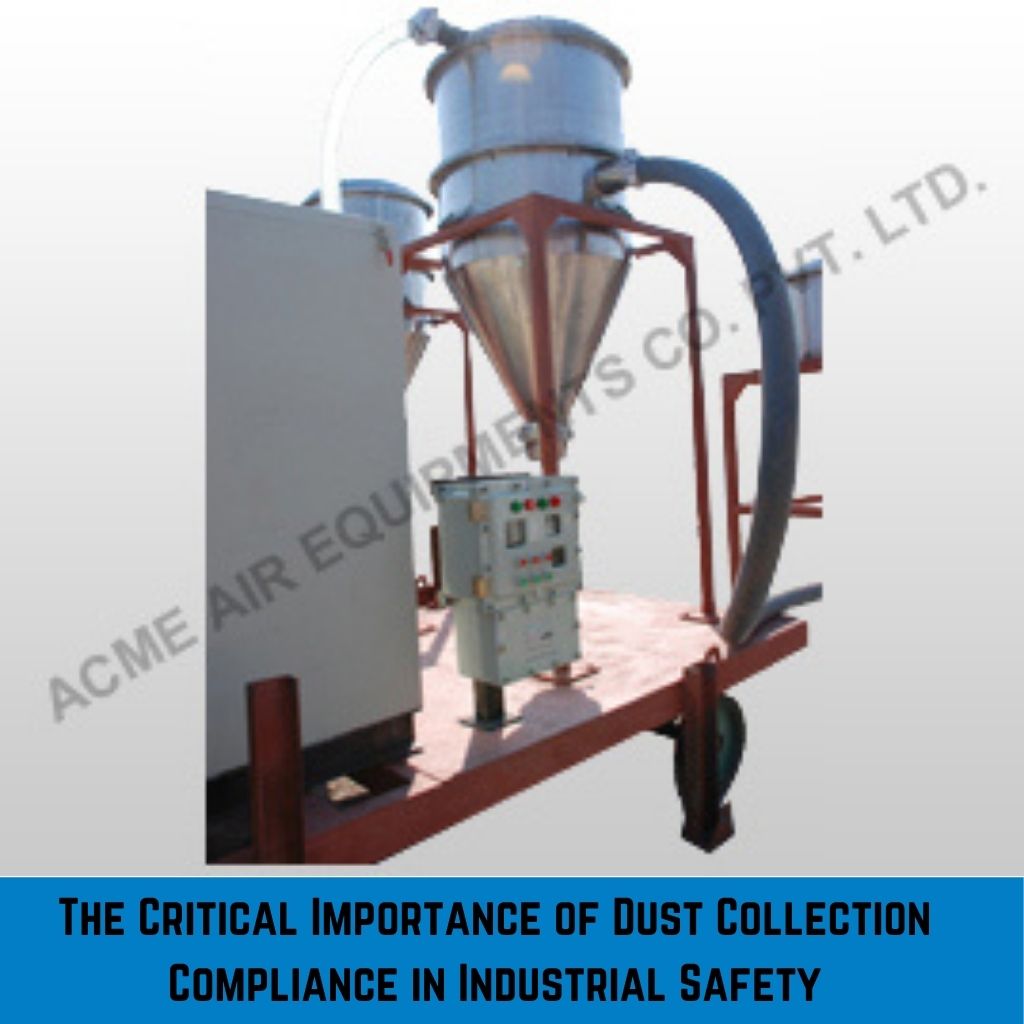
Regulators in North America, Europe, and Asia-Pacific have responded with increasingly detailed and enforceable standards. Whether your facility processes wood, metal, grain, pharmaceutical ingredients, plastics, or chemicals, your dust collection system is subject to a framework of standards that carry legal force — and non-compliance exposes your business to enforcement action, civil liability, elevated insurance premiums, and most critically, the risk of catastrophic loss of life and property.
This guide provides a clear, step-by-step pathway to achieving and maintaining compliance across the full lifecycle of your dust collection system.
Critical Context: The NFPA estimates that combustible dust poses a significant explosion hazard in over 30,000 industrial facilities across the United States alone. The majority of incidents occur in facilities that believed their dust collection systems were adequate.
Key Standards Governing Industrial Dust Collection Systems
Before beginning any compliance programme, it is essential to identify which standards apply to your facility, your dust type, and your geographic jurisdiction. The principal frameworks include:
| Compliance Requirement | Applicable Standard |
|---|---|
| Combustible dust hazard identification and management | NFPA 652 (Standard on Combustible Dusts) |
| Industry-specific combustible dust (wood, metal, grain, textiles) | NFPA 654 / 664 / 484 / 61 |
| General industry ventilation and occupational exposure limits | OSHA 29 CFR 1910.94 / 1910.1000 |
| Equipment in explosive atmospheres (Europe) | ATEX Directive 2014/34/EU |
| Hazardous area classification and equipment selection | IEC 60079 / EN 13463 |
| Industrial ventilation design | ACGIH Industrial Ventilation Manual |
| Explosion protection (venting, suppression, isolation) | NFPA 68 / 69 / EN 14491 / EN 14373 |
| Pharmaceutical dust containment | EU GMP Annex 15 / ISPE Guidelines |
Always confirm the current edition of each applicable standard with your regulatory authority, as NFPA and ISO standards undergo regular revision cycles.
Step-by-Step: Building a Compliant Dust Collection System
|
1 |
STEP 1 Conduct a Formal Dust Hazard Analysis (DHA) The DHA is the mandatory starting point under NFPA 652. Engage a qualified dust hazard specialist to test your dust for Kst (deflagration index), Pmax (maximum explosion pressure), Minimum Explosible Concentration (MEC), Minimum Ignition Energy (MIE), and Minimum Ignition Temperature (MIT). These measured parameters determine the explosion hazard class of your dust, drive zone classification, and are legally required documentation. The DHA must be reviewed every five years or whenever process changes occur. |
|
2 |
STEP 2 Classify Hazardous Zones and Select Certified Equipment Using DHA results, classify all areas where dust clouds may form — including inside ductwork, filter housings, and collector bins — into the appropriate zone classification: Zone 20/21/22 under ATEX (Europe) or Class II Division 1/2 under NEC (North America). All electrical motors, sensors, controls, and lighting installed within classified zones must carry ATEX or IECEx certification matched to the dust group (IIIA, IIIB, or IIIC) and temperature class established in your DHA. |
|
3 |
STEP 3 Design Ductwork for Minimum Transport Velocity Ductwork must be sized to maintain minimum transport velocity — the airspeed required to keep dust particles suspended and prevent settling and accumulation inside ducts. Typical minimum transport velocities range from 3,500 to 4,500 ft/min (17–23 m/s) for wood and agricultural dusts, and 4,000 to 5,000 ft/min (20–25 m/s) for heavier metal dusts. Settled dust in ductwork creates secondary accumulation hazards and significantly degrades system capture efficiency at hoods and enclosures. |
|
4 |
STEP 4 Specify and Size Hood Capture Velocity Correctly Every dust generation point — each machine, grinding station, transfer point, or process enclosure — requires a capture hood designed to achieve sufficient face velocity to capture airborne dust before it escapes to the room. The ACGIH Industrial Ventilation Manual provides minimum capture velocity guidance by application: typically 100–200 ft/min for low-velocity, low-toxicity operations, up to 1,000–2,500 ft/min for high-velocity grinding and abrasive blasting. Under-sized hoods are the single most common cause of non-compliance failures during OSHA inspections. |
|
5 |
STEP 5 Install Explosion Protection on the Dust Collector Any dust collector handling combustible dust must be equipped with explosion protection in compliance with NFPA 68 (deflagration venting) or NFPA 69 (suppression, isolation, oxidant concentration reduction). Explosion vents must be sized using the Kst value from your DHA and must be positioned to vent to a safe external location or into a flameless vent device. Rotary isolation valves or chemical suppression barriers must prevent flame propagation back through ductwork into the facility. Never omit or substitute explosion protection components without re-engineering review. |
|
6 |
STEP 6 Implement Bonding and Grounding for Static Electricity Control Static electricity accumulation in ductwork, filter media, and collector bins can provide sufficient ignition energy to ignite many combustible dusts. All metal ductwork, collector housing, bin sections, and rotary valves must be electrically bonded and grounded to less than 10 ohms resistance to earth. In ATEX Zone 20 and Class II Division 1 environments, conductive filter bags and antistatic duct hose are mandatory. Verify grounding continuity quarterly using a calibrated resistance meter and document all readings. |
|
7 |
STEP 7 Establish a Written Housekeeping and Maintenance Programme NFPA 652 and OSHA both require written housekeeping procedures to prevent dust accumulation on horizontal surfaces to depths that could fuel a secondary explosion. Establish maximum permissible accumulation depths (typically 1/32 inch / 0.8 mm trigger depth for most combustible dusts), cleaning frequency schedules, and approved cleaning methods — vacuum collection or wet methods only; compressed air blow-down is prohibited in occupied spaces as it creates suspended dust clouds. Maintenance logs must record filter differential pressure readings, rotary valve inspections, explosion vent condition checks, and grounding test results. |
|
8 |
STEP 8 Train Employees and Document Everything OSHA requires that all employees who work with or near combustible dust processes receive documented training covering dust hazard awareness, the location and function of dust collection equipment, emergency procedures, and the facility’s written combustible dust programme. Training records, the written DHA, equipment certification documents, inspection logs, and maintenance records collectively form the compliance documentation package required during OSHA inspections, ATEX audits, and insurance underwriting reviews. Maintain all records for a minimum of five years. |
Compliance Reminder: NFPA 652 requires that a Dust Hazard Analysis be completed for all facilities handling combustible dust by qualified personnel, and that the DHA be reviewed and updated every five years or whenever a process change occurs that affects dust generation, handling, or collection.
Maintaining Compliance: Ongoing Verification Requirements
Achieving compliance is not a one-time event. Industrial dust collection systems are dynamic — process changes, production volume increases, new materials, and equipment wear all affect compliance status. A sustainable compliance programme requires:
- Quarterly inspection and testing of explosion vent devices, isolation valves, and suppression system actuation sensors
- Monthly filter differential pressure monitoring and filter bag inspection for blinding, tears, or bypass
- Monthly grounding and bonding continuity verification with documented resistance readings
- Annual review of the written DHA against current process conditions
- Immediate re-evaluation following any process change, new dust type introduction, or facility modification
- Annual employee retraining and documentation update
Total CFM = Sum of CFM of all dust sources + Safety Margin
Or in a more specific breakdown:
Total CFM = (CFM of dust source 1) + (CFM of dust source 2) + (CFM of dust source 3) + … + (Safety Margin)
For example:
If you have three dust collection points with 10,000 CFM, 15,000 CFM, and 12,000 CFM, the formula would look like this:
Conclusion: Compliance as a Continuous Commitment
Dust collection system compliance is not a bureaucratic obligation — it is the engineering and operational foundation that protects your workforce, your facility, and your business from one of manufacturing’s most devastating hazards. The eight-step framework presented here provides a structured, auditable pathway from initial hazard characterisation through to ongoing verification.
The investment required to achieve and maintain compliance is modest compared to the human, financial, and reputational cost of a combustible dust incident. Facilities that embed compliance into their operational culture — through rigorous DHA documentation, certified equipment selection, disciplined maintenance, and trained employees — consistently demonstrate that safety and productivity are complementary, not competing, goals.
FAQs
What is a Dust Hazard Analysis (DHA) and is it legally required?
A Dust Hazard Analysis is a formal evaluation of combustible dust hazards in a facility, covering dust properties (Kst, Pmax, MEC, MIE, MIT), process locations where dust clouds may form, and the adequacy of existing controls. NFPA 652 requires a DHA for all facilities that handle combustible dust, to be completed by a qualified person and reviewed every five years. In the U.S., OSHA cites facilities under the General Duty Clause for failure to conduct or act on a DHA.
What is the difference between ATEX and OSHA requirements for dust collection?
ATEX Directive 2014/34/EU is a European equipment certification framework requiring that all equipment installed in explosive dust atmospheres carries certification matched to the hazardous zone classification. OSHA 29 CFR 1910 is a U.S. performance-based regulatory framework focused on worker safety outcomes. Facilities in the EU must comply with ATEX; U.S. facilities comply with OSHA and NEC (NFPA 70) for equipment in classified areas. Many multinational manufacturers design systems to meet both frameworks simultaneously.
How do I determine the minimum transport velocity for my ductwork?
Minimum transport velocity is determined by the aerodynamic properties of your specific dust — primarily particle density, size distribution, and shape. The ACGIH Industrial Ventilation Manual provides empirically derived minimum transport velocities by dust category. For most organic dusts (wood, grain, food), values range from 3,500 to 4,000 ft/min. For heavier metallic dusts, 4,000 to 5,000 ft/min is typical. A ventilation engineer should verify these values with actual system measurements during commissioning.
Do explosion vents need to be replaced after an incident?
Yes. Explosion vent panels are single-use passive devices. After any deflagration event that actuates an explosion vent, the burst panel must be replaced before the collector is returned to service. The installation must also be inspected for ductwork damage, filter housing deformation, and any collateral damage to isolation and suppression systems. An incident investigation and DHA review should be conducted before restart to identify and correct the root cause.
How often should filter bags in a dust collector be inspected?
Filter bags should be inspected for differential pressure monthly using the collector's built-in manometer — a sustained rise in differential pressure indicates blinding or bag failure. Visual inspection of bag condition, including checking for tears, abrasion holes, and caked deposits, should be conducted at each planned maintenance interval, typically quarterly. Filter bags in continuous-duty pharmaceutical or food applications may require more frequent inspection depending on dust load and cleaning cycle frequency.
What are the housekeeping requirements under NFPA 652 for combustible dust?
NFPA 652 requires facilities to establish a written housekeeping programme that prevents dust accumulation on surfaces to depths that could fuel a secondary explosion if disturbed. The standard references a general guidance depth of 1/32 inch (0.8 mm), though this threshold varies by dust type and Kst value. Cleaning must use vacuum collection or wet methods — compressed air blow-down in occupied areas is prohibited because it generates suspended dust clouds that create primary explosion risk.
Can I use a standard industrial vacuum cleaner for cleaning combustible dust?
Only vacuum cleaners with ATEX/FM certification for the applicable dust class may be used to clean combustible dust in classified areas. Standard industrial vacuums may not provide sufficient filtration to prevent fine combustible dust from passing through the filter and accumulating in the motor compartment, creating an internal ignition risk. Certified Class II vacuum cleaners use conductive hoses, grounded collection vessels, and HEPA-rated filtration specifically rated for combustible dust service.
What documentation do I need for a dust collection compliance audit?
A comprehensive compliance audit package should include: the written Dust Hazard Analysis with dust test data; equipment certification records (ATEX, UL, FM approvals); ductwork design calculations; explosion protection device datasheets and installation records; grounding and bonding continuity test logs; filter inspection and differential pressure records; housekeeping programme and completion logs; employee training records with attendance signatures; and the facility's written combustible dust management programme.
How does static electricity cause dust explosions and how is it controlled?
Static electricity builds up on ductwork, filter media, and collector bins through the continuous movement of charged dust particles against surfaces. If the accumulated static charge exceeds the Minimum Ignition Energy (MIE) of the dust and discharges as a spark in the presence of a dust cloud within the explosive concentration range, ignition can occur. Control measures include bonding all metallic components to less than 10 ohms resistance to earth, specifying conductive filter media and antistatic hose in high-sensitivity applications, and monitoring grounding continuity regularly.
What is the penalty for non-compliance with OSHA combustible dust standards?
OSHA can cite facilities under the General Duty Clause (Section 5(a)(1) of the OSH Act) for combustible dust hazards, with serious violation penalties up to USD 15,625 per violation as of 2024, and willful or repeated violations up to USD 156,259 per violation. More significantly, non-compliance that contributes to a combustible dust incident exposes the facility, its management, and potentially individual safety personnel to civil litigation, criminal prosecution in cases of gross negligence, and potentially unlimited liability for damages.
About Author
CEO
Mr. Vishwesh Pardeshi is the CEO of Acme Air Equipments Company Pvt. Ltd., an industrial and engineering goods manufacturing company based in Ahmedabad, Gujarat (India). He has taken over the responsibility from founding Partners and Directors of the Company, and is now leading a talented group of professionals since 2020 by bringing in vast industrial and management expertise. By qualification, he holds a Bachelor Degree in Mechanical Engineering and also holds a MBA degree from reputed institutes. Under his leadership, the Company has successfully executed prestigious projects by delivering high quality and world class products from a state of the art manufacturing facility which combines CNC-enabled precision manufacturing and strong after sales support. In line with the Vision, Mission and Core Values of the Organization, Mr. Vishwesh Pardeshi continues to drive Quality, Reliability and Global Expansion at Acme Air Equipments Co. Pvt. Ltd.