







Table of Contents
AI-Generated Summary
This comprehensive guide provides a technical, step-by-step roadmap for sizing a Dust Collector in a multi-machine workshop environment. Navigating the complexities of Cubic Feet per Minute (CFM) requirements and Static Pressure (SP) loss, the article breaks down how to calculate the specific needs of a centralized extraction system. Readers will learn how to identify the “worst-case” machine branch, account for ductwork friction, and select a collector that ensures optimal Air Velocity for both safety and performance. By focusing on the physics of airflow and the strategic layout of blast gates, this guide empowers workshop managers to build a scalable, high-efficiency dust mitigation strategy that protects both machinery and respiratory health.
Introduction
In a professional or high-output hobbyist workshop, dust collection is not merely about keeping the floor clean; it is a critical matter of occupational safety and machine longevity. Fine wood dust and industrial particulates are respiratory hazards and potential combustible risks. When moving from a single-shop vacuum to a multi-machine extraction system, “guessing” the size of your collector can lead to clogged pipes or wasted energy.
Proper sizing requires an understanding of two fundamental aerodynamic principles: Volume (CFM) and Resistance (Static Pressure).
Step 1: Determine Your CFM Requirements
The first step is identifying the air volume needed to move dust from your machines into the ducting. Every machine has a minimum CFM (Cubic Feet per Minute) requirement based on the volume of waste it produces.
- Small Tools (Scroll saws, small sanders): ~250–350 CFM.
- Standard Tools (Table saws, 12” planers): ~400–550 CFM.
- Large Tools (20”+ Planers, Wide-belt sanders): ~700–900+ CFM.
The Multi-Machine Rule: In most workshops, you do not size the system for every machine running simultaneously. You size it for the highest-demand machine (or the combination of machines) that will be used at once. If you use blast gates to close off unused lines, your collector only needs to satisfy the CFM of the open gates.
Read Our Article
Environmental Impact of Dust Collectors: Reducing Dust EmissionsStep 2: Calculate Air Velocity (FPM)
To keep dust suspended in the air and moving through horizontal pipes, you must maintain a minimum Air Velocity, measured in Feet per Minute (FPM).
- For Wood Dust: A velocity of 3,500 to 4,000 FPM is the industry standard for main ducts to prevent “settling” or “drifting” in the pipes.
- Calculated Formula: $CFM = Area \times Velocity$. This means if you need 400 CFM at a machine, your pipe diameter must be sized correctly to maintain that 4,000 FPM velocity.
Step 3: Map the “Worst-Case” Duct Run
Static Pressure (SP) is the resistance the collector must overcome to move air. This resistance comes from friction against pipe walls, bends, and filters. To size your system, you must find the most restrictive path—usually the longest run with the most elbows.
- Measure the Length: Total linear feet of straight pipe.
- Count the Fittings: Every 90° elbow or 45° wye adds “Equivalent Linear Feet” of resistance.
- Account for the Filter: A seasoned filter bag or a high-efficiency HEPA canister adds significant static pressure (often 0.5″ to 1.5″ SP).
Step 4: Calculate Total Static Pressure Loss
Using a static pressure loss chart, calculate the total resistance of your worst-case run.
- Duct Friction: Roughly 0.05″ to 0.1″ of SP loss per 10 feet of smooth-wall pipe.
- Flex Hose: Ribbed flex hose is an “airflow killer.” It can have three times the resistance of smooth metal pipe. Keep flex runs to a minimum.
- Machine Hood: The transition from the machine to the hose typically accounts for ~1.0″ to 2.0″ of SP loss.
Example Calculation:
- Machine Hood Loss: 1.5″ SP
- 30 ft of 6″ pipe: 0.3″ SP
- Three 90° Elbows: 0.6″ SP
- Filter Loss: 1.0″ SP
- Total System Resistance: 3.4″ SP
Step 5: Compare Data to a Fan Curve
Dust collectors are rated by manufacturers at “Free Air” (0″ Static Pressure), which is a misleading number. To find the true performance, you must look at the Fan Curve or Performance Curve provided by the manufacturer.
If your calculation says you need 800 CFM at 3.5″ of Static Pressure, you must find a collector whose curve intersects at or above those coordinates. If the collector only provides 600 CFM at 3.5″ SP, your air velocity will drop, and dust will pile up in your pipes.
Our Other Product
Twin Lobe Roots BlowerStep 6: Choose the Right Collector Type
- Single-Stage Collectors: The air and dust go through the impeller together. These are affordable but lose efficiency quickly as the bag fills.
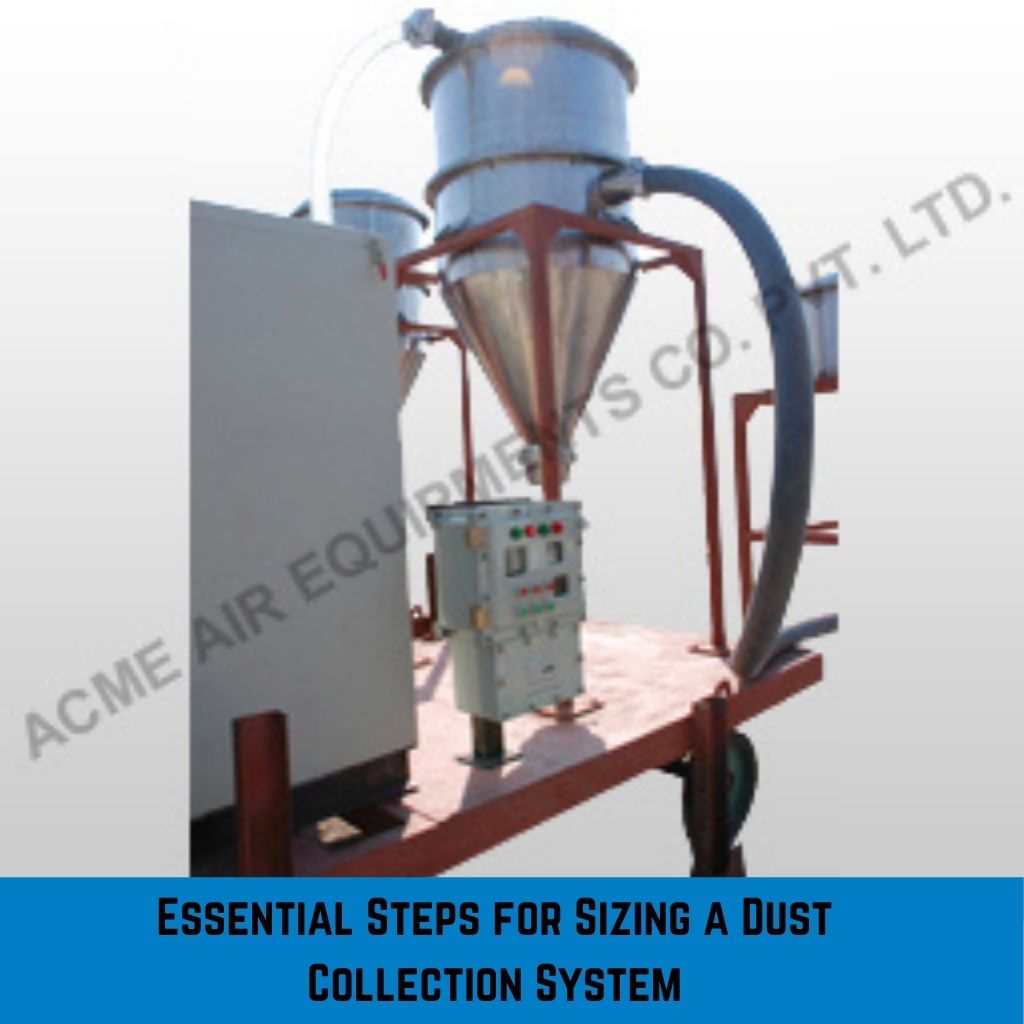
- Two-Stage Cyclones: A cyclone separator removes large chips before the air reaches the impeller and filter. These maintain a much more consistent CFM and are the gold standard for multi-machine workshops.
Step 7: Final Implementation and Testing
Once the collector is installed, use a Pitot tube or an Anemometer to verify the FPM at your furthest machine. If the velocity is below 3,500 FPM, you may need to increase the pipe diameter of your main trunk or upgrade to a more powerful impeller.
Frequently Asked Questions
How to Size a Dust Collector for a Multi-Machine Workshop: A Step-by-Step Guide
Can I use a shop vac for a multi-machine system?
Generally, no. Shop vacs move a low volume of air (high SP, low CFM) through small hoses. They are "high vacuum, low volume" tools. A dust collector is a "low vacuum, high volume" machine necessary for the large ports found on table saws and planers.
What is the best material for workshop ducting?
Smooth-wall metal ducting (spiral or snap-lock) is best because it has the lowest friction loss and is naturally grounded against static electricity. PVC is common in hobby shops but requires careful grounding to prevent static discharge.
How does a clogged filter affect my sizing?
A clogged filter increases Static Pressure significantly. If your system is sized too close to its limit, a dirty filter will drop your CFM below the "suspension velocity," causing dust to settle in your ducts.
Do blast gates really help?
Yes. By closing gates on machines not in use, you concentrate the full CFM and SP of the collector onto a single machine, allowing a smaller collector to serve a large shop.
Should I use 4-inch or 6-inch ducting?
For most machines requiring 400+ CFM, a 6-inch main trunk is preferred. A 4-inch pipe often restricts airflow so much that you cannot maintain the necessary CFM, regardless of how big the motor is on the dust collector.
What is a "long-radius" elbow?
A long-radius elbow has a gradual curve rather than a sharp turn. Using these reduces Static Pressure loss significantly compared to standard "short" elbows.
What is the difference between a 1-hp and a 3-hp collector?
The horsepower generally dictates the size of the impeller. A larger impeller can move more air (CFM) and overcome higher resistance (SP). Most multi-machine shops require at least a 2-hp to 3-hp unit.
How do I ground my ductwork?
For metal ducts, the pipes themselves are the ground. For PVC, you should run a copper wire through the inside of the pipe or wrapped tightly around the outside, connected to the collector's chassis and the machine.
Why is air velocity (FPM) more important than just CFM?
CFM is the amount of air, but FPM is the speed. If the speed is too low, the dust won't "fly"; it will just fall to the bottom of the pipe, eventually causing a total blockage.
Can I run two machines at once on one collector?
Yes, but you must add their CFM requirements together. If both require 400 CFM, your system must be able to pull 800 CFM at the combined static pressure of both runs.

CEO
Mr. Vishwesh Pardeshi is the CEO of Acme Air Equipments Company Pvt. Ltd., an industrial and engineering goods manufacturing company based in Ahmedabad, Gujarat (India). He has taken over the responsibility from founding Partners and Directors of the Company, and is now leading a talented group of professionals since 2020 by bringing in vast industrial and management expertise. By qualification, he holds a Bachelor Degree in Mechanical Engineering and also holds a MBA degree from reputed institutes. Under his leadership, the Company has successfully executed prestigious projects by delivering high quality and world class products from a state of the art manufacturing facility which combines CNC-enabled precision manufacturing and strong after sales support. In line with the Vision, Mission and Core Values of the Organization, Mr. Vishwesh Pardeshi continues to drive Quality, Reliability and Global Expansion at Acme Air Equipments Co. Pvt. Ltd.