






Table of Contents
Why Do Power Plants Need Rotary Compressors?
A coal fired thermal power station generates approximately 15 to 35 percent of its coal input as ash, divided between fly ash collected in electrostatic precipitators and bag filters, and bottom ash from the furnace floor. In a 500 MW power plant burning 200 tonnes of coal per hour, this generates 30 to 70 tonnes of ash per hour that must be continuously conveyed to storage silos or disposal areas. Rotary compressors and pneumatic conveying systems are the primary technology for this duty.
Beyond ash handling, power plants use roots blowers and rotary compressors for: cooling tower basin aeration to control biological growth, instrument air supply as the motive source for pneumatically operated control valves, coal dust conveying from pulverisers to burner systems, and biomass feeding in co firing installations.

Fly Ash and Bottom Ash Pneumatic Conveying
Fly ash from coal combustion is a fine, relatively light powder with bulk densities of 700 to 1,100 kilograms per cubic metre. It is highly abrasive, with silica and alumina content giving it an effective Mohs hardness of 5 to 6. High velocity dilute phase conveying of fly ash causes rapid pipeline wear, particularly at bends, and is therefore avoided in favour of dense phase or moderate velocity dilute phase conveying with hardened pipeline.
For dilute phase fly ash conveying at reduced velocity, rotary compressors delivering 0.5 to 0.8 bar gauge are specified. For dense phase fly ash conveying, operating pressures of 2 to 4.5 bar are required, calling for screw compressors or high pressure rotary compressors at the inlet vessel.
Bottom ash is coarser and heavier than fly ash, with larger particle sizes up to 10 millimetres. It typically requires water sluicing followed by dewatering before pneumatic conveying, or direct dense phase conveying with specially designed pipeline and hardened bends. The rotary compressor operating pressure for bottom ash conveying is typically 2 to 5 bar, with higher values for longer distance systems.
Read Our Article
How to Prevent Moisture Contamination in Oil-Sealed Vacuum Pumps?
Design Considerations for Ash Conveying Rotary Compressors
Continuous duty 24 hours per day is the standard operating requirement for ash handling compressors at a power plant. The following design features must be incorporated:
- **Dual unit configuration** with one operating and one on standby, with automatic changeover on high temperature or high current alarm, to allow maintenance without production stoppage
- **High temperature rated seals and elastomers** since ambient temperatures in boiler house locations can exceed 50 degrees Celsius, and radiated heat from the boiler structure requires oil and seal materials rated to at least 100 degrees Celsius
- **IP54 minimum enclosure rating** for the motor to protect against the heavy dust environment in the precipitator and ash conveying areas
- **Separate inlet air filtration** with multi stage filters removing fly ash from the inlet air before it enters the blower casing. Fly ash ingestion into the timing gear casing is highly damaging and a common cause of premature wear in power plant installations
- **Vibration isolation mounting** to protect the precision timing gears from structure borne vibration from adjacent equipment

Cooling Tower Basin Aeration
Natural draught and mechanical draught cooling towers develop biological growth in the warm, nutrient rich basin water if the dissolved oxygen level falls. Legionella bacteria are a particular concern where cooling tower water is in contact with air in an occupied facility. Continuous aeration of the basin using submerged diffusers maintains dissolved oxygen and inhibits anaerobic bacterial activity.
The pressure requirement for cooling tower basin aeration is modest, typically 0.2 to 0.4 bar above atmospheric at the diffuser inlet. Flow requirements depend on basin volume, with a typical target of 2 to 4 litres of air per minute per square metre of basin surface area. Acme twin lobe roots blowers in the 300 to 2,000 cubic metre per hour range cover most cooling tower aeration applications in power stations.
Our Other Product
Instrumentation Air Supply
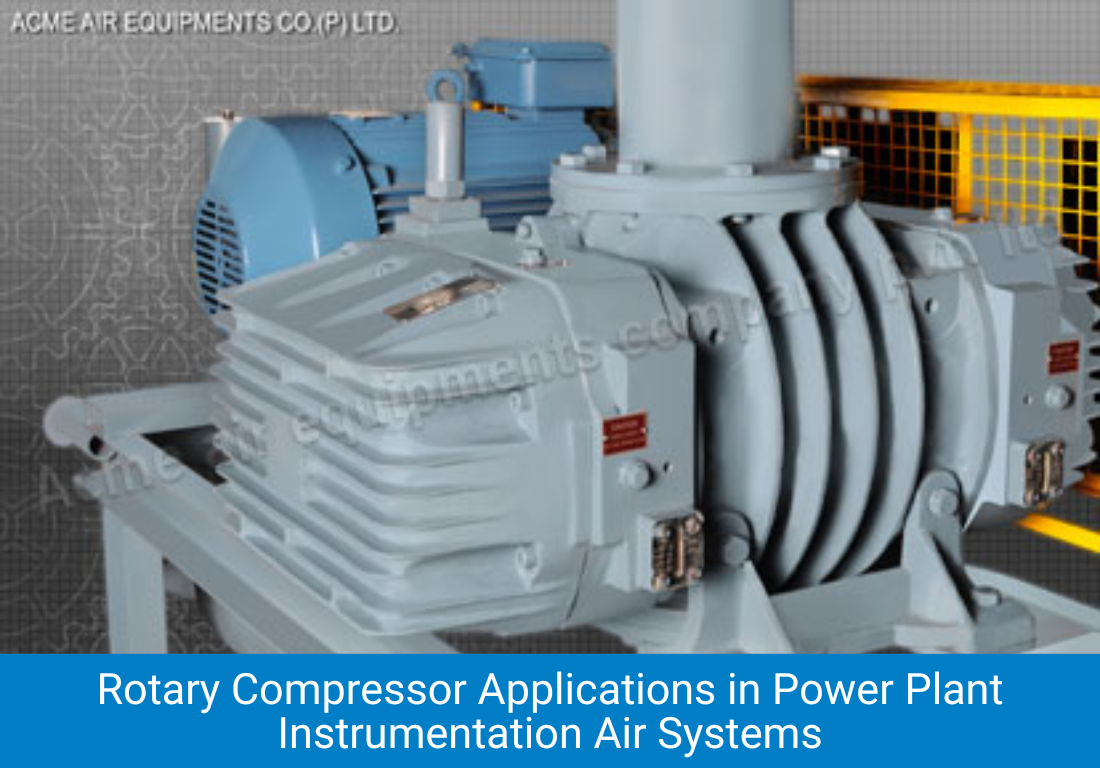
Pneumatically operated control valves, positioners, and actuators across a power plant require a clean, dry, oil free air supply at 5 to 8 bar gauge. While this pressure range is above the operating range of a roots blower, the requirement for oil free air places the rotary screw compressor rather than an oil injected machine as the standard supply source. However, for instrument air supply at lower pressures in specific areas, Acme’s tri lobe rotary compressors at 3 bar gauge can supply instrument air when combined with appropriate dryers and filters.
The critical quality requirements for instrument air per ISO 8573 Class 1 are: maximum particle size 0.1 microns, maximum water pressure dew point minus 40 degrees Celsius at line pressure, and maximum oil content 0.01 milligrams per cubic metre. These can be achieved with appropriate downstream treatment of compressed air from Acme’s oil free rotary compressor.
Frequently Asked Questions
Rotary Compressor in Power Plants: Coal and Ash Conveying, Cooling Tower Aeration, and Instrumentation Air
What type of pneumatic conveying system is used for fly ash in a thermal power plant?
Both dilute phase and dense phase pneumatic conveying systems are used for fly ash. Dense phase at 2 to 4.5 bar is preferred for longer distances and higher abrasion resistance requirements. Dilute phase at 0.5 to 0.8 bar is used for shorter distances where moderate velocity conveying with hardened pipeline is sufficient. The dense phase system uses pressure vessels at the pickup point and a high pressure rotary compressor or screw compressor as the air source.
Why is oil free air important for power plant instrumentation?
Control valve actuators and positioners in power plants contain precision orifices and elastomeric seals that are damaged by oil in the compressed air supply. Oil contamination causes sticky actuator response, positioning errors, and premature actuator seal deterioration that can compromise control loop performance and plant safety. Acme's oil free rotary compressors deliver air without any lubricant in the gas stream, meeting ISO 8573 Class 0 oil content requirement when combined with appropriate downstream filtration.
How is the roots blower protected from fly ash ingestion in a power plant installation?
The inlet air supply to the roots blower should be drawn from a clean air source well away from the ash handling area, or through a dedicated inlet filter system capable of removing particles down to 5 microns. A multi stage filter with an initial mesh screen, a centrifugal separator stage, and a final paper element is standard for power plant installations. The pressure differential across the inlet filter should be monitored continuously, with high pressure differential alarm set at the filter manufacturer's recommended replacement threshold.
CEO
Mr. Vishwesh Pardeshi is the CEO of Acme Air Equipments Company Pvt. Ltd., an industrial and engineering goods manufacturing company based in Ahmedabad, Gujarat (India). He has taken over the responsibility from founding Partners and Directors of the Company, and is now leading a talented group of professionals since 2020 by bringing in vast industrial and management expertise. By qualification, he holds a Bachelor Degree in Mechanical Engineering and also holds a MBA degree from reputed institutes. Under his leadership, the Company has successfully executed prestigious projects by delivering high quality and world class products from a state of the art manufacturing facility which combines CNC-enabled precision manufacturing and strong after sales support. In line with the Vision, Mission and Core Values of the Organization, Mr. Vishwesh Pardeshi continues to drive Quality, Reliability and Global Expansion at Acme Air Equipments Co. Pvt. Ltd.