






Table of Contents
Why Are Pharmaceutical and Chemical Dust Collection Systems Different?
A standard industrial dust collector for woodworking or cement handling is designed to collect large quantities of relatively inert dust with moderate filtration efficiency. Pharmaceutical and chemical dust collection operates under an entirely different set of requirements:
- **Zero tolerance for product loss**, since pharmaceutical powders are high value materials where even small collection inefficiencies represent significant financial loss
- **Zero tolerance for cross contamination**, particularly in multi product facilities where different drug substances use the same production area
- **Worker protection requirements** for highly potent active pharmaceutical ingredients (HPAPIs), where occupational exposure limits (OELs) can be as low as 0.1 micrograms per cubic metre of air
- **Explosion risk management** since many pharmaceutical powders including lactose, starch, and paracetamol have minimum explosive concentration (MEC) values that are reached during normal processing
- **Regulatory compliance** with pharmaceutical GMP (Good Manufacturing Practice) requirements that specify the design, validation, and documentation of all dust control systems

Understanding Combustible Dust Classification
Combustible dusts are classified by their explosivity index (Kst value) and maximum explosion pressure (Pmax) measured in standardised tests. The St classification system is the internationally recognised framework:
| Classification | Kst Value (bar.m/s) | Typical Pharmaceutical Examples | Risk Level |
|---|---|---|---|
| St 0 (non explosive) | 0 | Calcium sulphate, talc | No explosion risk |
| St 1 (weakly explosive) | 1 to 200 | Aspirin, citric acid, starch | Moderate explosion potential |
| St 2 (strongly explosive) | 200 to 300 | Sugar, lactose, paracetamol | High explosion potential |
| St 3 (very strongly explosive) | Above 300 | Metallic powders, some organic pigments | Very high explosion potential |
Most pharmaceutical powders fall into St 1 or St 2 categories. Chemical plant dusts range from St 0 for mineral dusts to St 3 for some organic intermediates and metallic powders. The Kst and Pmax values for the specific material being collected must be known before the dust collection system can be designed, as they determine the explosion vent area and suppression system specifications.
ATEX Zone Classification in Pharmaceutical and Chemical Facilities
ATEX Directive (Equipment and Protective Systems for Use in Potentially Explosive Atmospheres) requires that areas where explosive dust atmospheres may occur are classified into zones based on the frequency and duration of the explosive atmosphere:
- **Zone 20** is an area where an explosive dust atmosphere exists continuously, for long periods, or frequently. The interior of dust collection hoppers, filter housings, and cyclone bodies is typically Zone 20
- **Zone 21** is an area where an explosive dust atmosphere is likely to occur during normal operation. The area around dust loading points, the interior of enclosed conveying systems, and the immediate vicinity of dust collector inlets is typically Zone 21
- **Zone 22** is an area where an explosive dust atmosphere is not likely to occur during normal operation but may occur in abnormal conditions. Areas around sealed pipe connections and distant from primary dust generation sources are typically Zone 22
All equipment installed within these zones must be ATEX certified for the appropriate zone and dust group. Electrical equipment for Zone 20 must be Category 1D, for Zone 21 Category 2D, and for Zone 22 Category 3D.
Explosion Protection Measures for Dust Collection Systems
Explosion Venting
Explosion venting is the most common primary protection measure for dust collectors in pharmaceutical and chemical plants. Burst panel vents or mechanical flap vents are sized to release the explosion pressure through a duct to a safe external location before it exceeds the structural strength of the dust collector vessel. The vent area is calculated using the EN 14491 standard based on the Kst and Pmax values of the collected dust and the volume of the dust collector.
For indoor installations where direct external venting is not possible, flameless vent devices that combine a burst panel with a stainless steel mesh flame arrester are available. These allow the explosion pressure wave to be vented internally without releasing flame or burning particles into the building.
Chemical Suppression Systems
For high Kst dusts, dusts with very low MEC, or installations where venting to a safe external area is not possible, active chemical suppression is used. Suppressant agent (usually ammonium phosphate or sodium bicarbonate) is injected into the vessel by high speed actuators triggered by pressure detectors that detect the initial pressure rise of the incipient explosion. The suppressant agent quenches the combustion before explosion pressure reaches damaging levels.
Grounding and Bonding
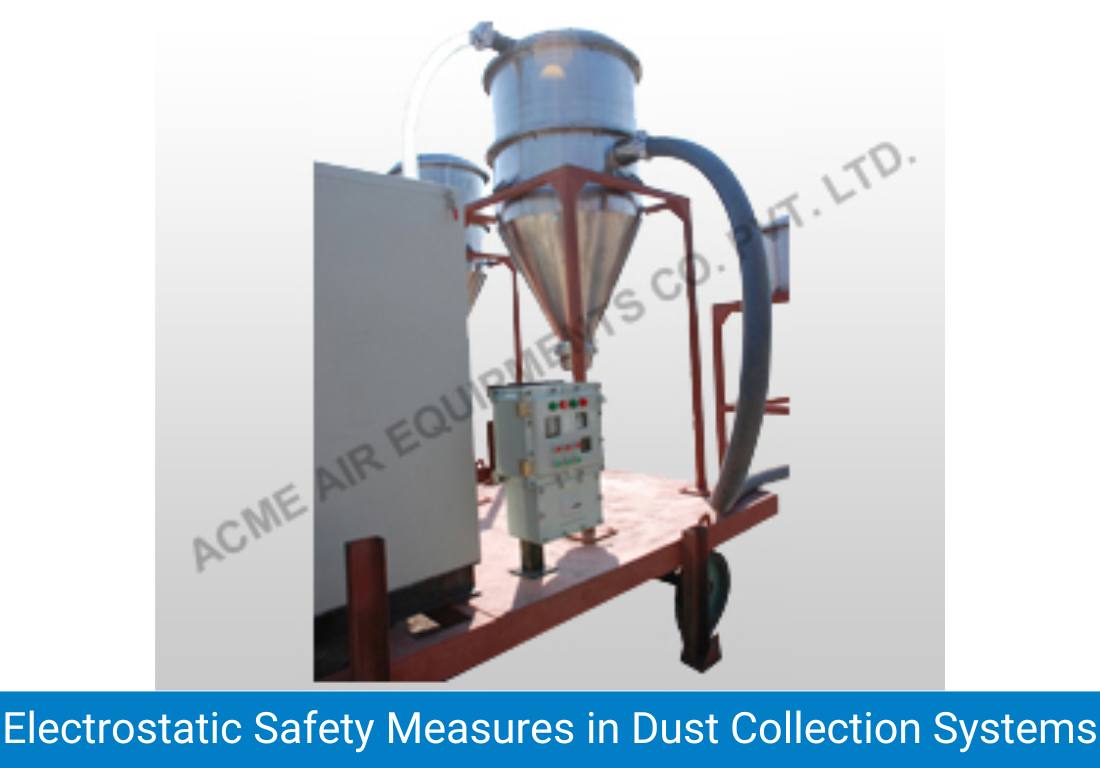
Electrostatic charge generation is inherent in the movement of fine powder through ductwork and filter surfaces. If this charge accumulates to a sufficient potential, an incendive spark can ignite a combustible dust cloud. All dust collection equipment in explosive atmosphere zones must be continuously grounded to less than 10 ohms resistance, and all conductive components must be bonded together. Conductive filter bags with earthing strips are required where bag resistance could otherwise allow charge accumulation.
Nitrogen Inerting
For extremely sensitive dusts such as metal powders, some drug intermediates, and self igniting materials, explosion protection by dilution with nitrogen is used instead of, or in addition to, venting and suppression. Nitrogen purging maintains the oxygen content within the dust collector below the limiting oxygen concentration (LOC) of the material, preventing explosive atmosphere formation entirely. This approach requires continuous oxygen monitoring and a reliable nitrogen supply.
Filtration Efficiency Requirements for Pharmaceutical Facilities
Standard industrial dust collectors achieve outlet concentrations of 1 to 5 milligrams per cubic metre with conventional polyester filter bags. For highly potent pharmaceutical powders with OELs below 10 micrograms per cubic metre, even a single escape event at this concentration is unacceptable. HEPA after filters or cartridge filters with HEPA laminate media achieving 99.995 percent minimum efficiency at 0.3 micron particle size are required for these applications.
Acme Air Equipments designs pharmaceutical dust collection systems with stainless steel filter housings that meet GMP surface finish requirements, H14 class HEPA terminal filters on the clean air outlet, and containment features that allow bag change and maintenance without dust exposure to the operator.
Frequently Asked Questions
What is the ATEX certification requirement for a dust collector in a pharmaceutical plant?
For a dust collector installed in a Zone 21 area, which covers most pharmaceutical processing environments where dust is generated during normal operation, all electrical components including the pulse jet solenoid valves, motor, and control panel must be certified ATEX Category 2D, Group IIIA or IIIB depending on the dust layer ignition temperature. Mechanical components must also be certified to prevent potential ignition sources such as hot surfaces, friction, or impact sparks.
How is the explosion vent area for a pharmaceutical dust collector calculated?
Explosion vent area is calculated using the EN 14491 standard, which requires the Kst value and maximum explosion pressure of the specific dust, the volume of the dust collector, the location (indoor or outdoor), and the strength of the vessel. The calculation produces the minimum vent area in square metres. Acme's process engineers carry out this calculation as part of the system design and ensure that the specified burst panel or flap vent is correctly sized and certified.
Can a standard bag filter be used for collecting pharmaceutical dust?
A standard industrial bag filter using woven or needlefelt polyester bags is not suitable for pharmaceutical applications where highly potent compounds are involved. Pharmaceutical systems require HEPA rated laminate media bags or HEPA after filters, GMP smooth stainless steel surfaces with no crevices for contamination accumulation, validated bag change procedures with operator containment, and documentation suitable for inclusion in regulatory submissions.
About Author
CEO
Mr. Vishwesh Pardeshi is the CEO of Acme Air Equipments Company Pvt. Ltd., an industrial and engineering goods manufacturing company based in Ahmedabad, Gujarat (India). He has taken over the responsibility from founding Partners and Directors of the Company, and is now leading a talented group of professionals since 2020 by bringing in vast industrial and management expertise. By qualification, he holds a Bachelor Degree in Mechanical Engineering and also holds a MBA degree from reputed institutes. Under his leadership, the Company has successfully executed prestigious projects by delivering high quality and world class products from a state of the art manufacturing facility which combines CNC-enabled precision manufacturing and strong after sales support. In line with the Vision, Mission and Core Values of the Organization, Mr. Vishwesh Pardeshi continues to drive Quality, Reliability and Global Expansion at Acme Air Equipments Co. Pvt. Ltd.