






Table of Contents
Why Are Roots Blowers Used in Wastewater Aeration?
A pipeline blockage is the most disruptive failure in a pneumatic conveying system and the one most frequently encountered. The conveying air continues to flow but material stops moving, pressure at the blower or compressor discharge rises steeply, and throughput falls to zero.Biological treatment of sewage and industrial effluent requires continuous supply of air or oxygen to support the aerobic bacteria that break down organic contaminants. This air is delivered through diffuser systems on the floor of aeration tanks, and the pressure required at the blower discharge is determined by the depth of the diffuser below the water surface plus the frictional resistance of the diffuser elements and connecting pipework.
For a typical wastewater treatment plant with diffusers at a depth of 4 to 6 metres below the surface, the required differential pressure at the blower is approximately 0.45 to 0.65 bar gauge. This range falls exactly within the operating envelope of a roots blower, making it the preferred machine for aeration duty worldwide.
Key reasons roots blowers dominate wastewater aeration applications include: their positive displacement characteristic delivers consistent air volume regardless of modest changes in back pressure, which maintains stable dissolved oxygen levels in the tank. They deliver 100 percent oil free air, which is essential for biological treatment processes where oil contamination would kill the aerobic bacteria. They are mechanically simple with no internal compression, giving them long service life in continuous 24 hour operation.
What Flow and Pressure Ratings Are Needed for Wastewater Aeration?
Aeration system design starts with the oxygen demand of the biological process, which is calculated from the biochemical oxygen demand (BOD) loading of the incoming wastewater. The required air volume at the blower is then derived by applying an oxygen transfer efficiency factor for the diffuser type.
For a municipal sewage treatment plant treating 5 million litres per day with a BOD loading of 200 milligrams per litre, the required aeration air volume is typically in the range of 2,000 to 5,000 cubic metres per hour. Multiple blowers operating in parallel with one standby unit are used to provide both the required total capacity and N plus 1 redundancy.
Acme Air Equipments supplies tri lobe roots blowers for wastewater aeration from 300 to 18,000 cubic metres per hour at pressure differentials of 0.3 to 1.0 bar, covering the full range from small effluent treatment plants to large municipal sewage treatment plants.
What Are the Specific Requirements for Biogas Blowers?
Biogas from anaerobic digestion of organic waste, sewage sludge, or agricultural material contains methane (50 to 70 percent), carbon dioxide (30 to 50 percent), and traces of hydrogen sulphide, water vapour, and siloxanes. Each of these components presents a specific engineering challenge for the blower:
- **Methane is flammable**, which requires that all electrical components in the blower motor and control panel be rated for Zone 1 or Zone 2 hazardous area classification, typically specified as Ex d IIB T3 or better
- **Hydrogen sulphide is corrosive** to standard mild steel casings and timing gears. Stainless steel internals or special coating of H2S exposed surfaces is required for sour biogas applications
- **Water vapour condensation** inside the casing can wash away lubrication and cause corrosion. Drain points at the lowest casing points and water trap arrangements on the inlet piping are required
- **Siloxanes** form silicon dioxide deposits on internal surfaces at elevated temperatures. For high siloxane biogas, upstream siloxane removal is recommended before the blower
Tri Lobe vs Twin Lobe Roots Blower for Biogas and Wastewater Duty
Both twin lobe and tri lobe roots blowers can be specified for aeration and biogas duty, but the tri lobe design has specific advantages for these continuous duty applications:
The tri lobe rotor sweeps 6 volumes per revolution compared to 4 for a twin lobe rotor. This allows the tri lobe machine to run at lower rotational speed to deliver the same airflow, which directly reduces noise and vibration levels. In a wastewater treatment plant that operates continuously 24 hours a day, lower noise is a significant operational benefit, particularly where the plant is close to residential areas.
The tri lobe profile also delivers smoother, more continuous flow with lower pressure pulsation amplitude. In diffuser aeration applications, reduced pulsation means more uniform dissolved oxygen distribution across the aeration tank and less mechanical stress on diffuser membranes.
For biogas compression, the lower rotational speed of a tri lobe unit for a given duty point also reduces the heat generated in the biogas stream. Since biogas temperature must be kept below the ignition margin for the methane air mixture at the discharge, the lower compression temperature of a tri lobe machine provides an additional safety margin.
Motor Specification for Wet Environment Installations
Wastewater treatment plants and biogas plants are consistently wet, humid, and often chemically aggressive environments. The standard motor for these installations should be specified as:
- IP55 or IP65 ingress protection rating minimum, with IP65 preferred for locations directly exposed to hose down cleaning or rain
- IE3 energy efficiency class motor to comply with Indian Bureau of Energy Efficiency requirements and to minimise continuous duty electricity costs
- Class F insulation with Class B temperature rise for extended thermal life under continuous operation
- IEC flange mounting with direct drive to the blower shaft to eliminate belt transmission losses and V belt replacement requirements
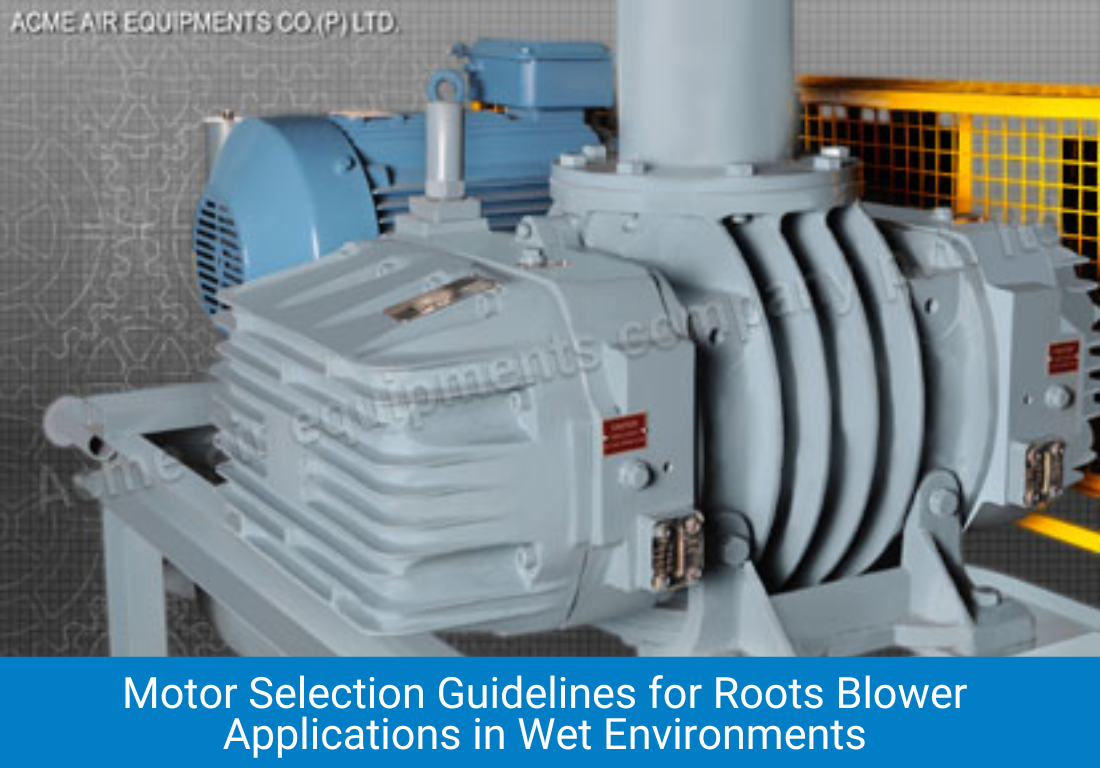
- ATEX or PESO certified motor for biogas plant installations where the blower is located within the hazardous zone around the biogas storage vessel
Energy Efficiency and Specific Power Comparison
For wastewater treatment plants, the aeration system typically accounts for 50 to 70 percent of the total plant electricity consumption, making blower efficiency directly proportional to operating cost. Acme’s tri lobe roots blowers achieve volumetric efficiencies of 90 to 95 percent across the design operating range, compared to 80 to 88 percent for older generation twin lobe machines of equivalent capacity.
For a wastewater treatment plant with a total aeration air requirement of 5,000 cubic metres per hour operating at 0.55 bar differential, replacing older twin lobe blowers with Acme tri lobe machines can reduce aeration electricity consumption by 8 to 15 percent, depending on the age and condition of the existing machines. Over a 10 year plant life, this represents a substantial cost saving that significantly exceeds the initial investment difference.
Frequently Asked Questions
What pressure does a roots blower need to deliver for submerged aeration diffusers?
For fine bubble disc diffusers at a submergence depth of 4 to 5 metres, the required blower discharge pressure is approximately 0.45 to 0.60 bar gauge. For coarse bubble dome diffusers at 3 to 4 metres depth, the required pressure is slightly lower at 0.35 to 0.50 bar gauge. The total pressure includes the hydrostatic head at the diffuser depth plus the diffuser system resistance.
Can a roots blower handle biogas containing hydrogen sulphide?
Yes, but with appropriate material specification. For biogas containing up to 200 ppm of hydrogen sulphide, epoxy coated casing internals and stainless steel timing gears provide adequate protection. For sour biogas with H2S levels above 500 ppm, upstream H2S removal using iron sponge or activated carbon is strongly recommended before the blower inlet to protect the machine and downstream equipment.
What is the advantage of a variable speed drive on a wastewater aeration blower?
A variable speed drive allows the blower to modulate its output to match the actual oxygen demand of the biological process, which varies significantly with time of day and seasonal loading. Without a VSD, the blower runs at constant speed and excess air is vented, wasting energy. A properly specified VSD typically reduces aeration energy consumption by 20 to 35 percent compared to constant speed operation with throttling.
About Author
CEO
Mr. Vishwesh Pardeshi is the CEO of Acme Air Equipments Company Pvt. Ltd., an industrial and engineering goods manufacturing company based in Ahmedabad, Gujarat (India). He has taken over the responsibility from founding Partners and Directors of the Company, and is now leading a talented group of professionals since 2020 by bringing in vast industrial and management expertise. By qualification, he holds a Bachelor Degree in Mechanical Engineering and also holds a MBA degree from reputed institutes. Under his leadership, the Company has successfully executed prestigious projects by delivering high quality and world class products from a state of the art manufacturing facility which combines CNC-enabled precision manufacturing and strong after sales support. In line with the Vision, Mission and Core Values of the Organization, Mr. Vishwesh Pardeshi continues to drive Quality, Reliability and Global Expansion at Acme Air Equipments Co. Pvt. Ltd.