







Table of Contents
How Does a Twin Lobe Rotary Compressor Work?
A twin lobe rotary compressor, also called a twin lobe roots blower or lobe compressor, uses two figure eight shaped rotors mounted on parallel shafts within a close tolerance casing. Each rotor has two lobes. Precision timing gears mounted outside the gas stream keep the two rotors in perfect synchronisation so that they rotate without touching each other or the casing walls.
As the rotors turn, the lobes alternately open and close pockets between themselves and the casing. At the inlet, air is drawn into an open pocket. As the rotor continues to turn, the pocket is sealed and carries the trapped air around to the discharge side, where it is abruptly expelled into the discharge line. This abrupt expulsion of each air pocket creates a characteristic pulsation in the discharge air flow.
The twin lobe configuration sweeps 4 air volumes per revolution, meaning that at 1,500 RPM, the discharge sees 4 expulsion events per revolution multiplied by 1,500 revolutions per minute, giving a pulsation frequency of 100 Hertz. This relatively low frequency pulsation is audible and can be felt through connected pipework.
How Does a Tri Lobe Rotary Compressor Differ?
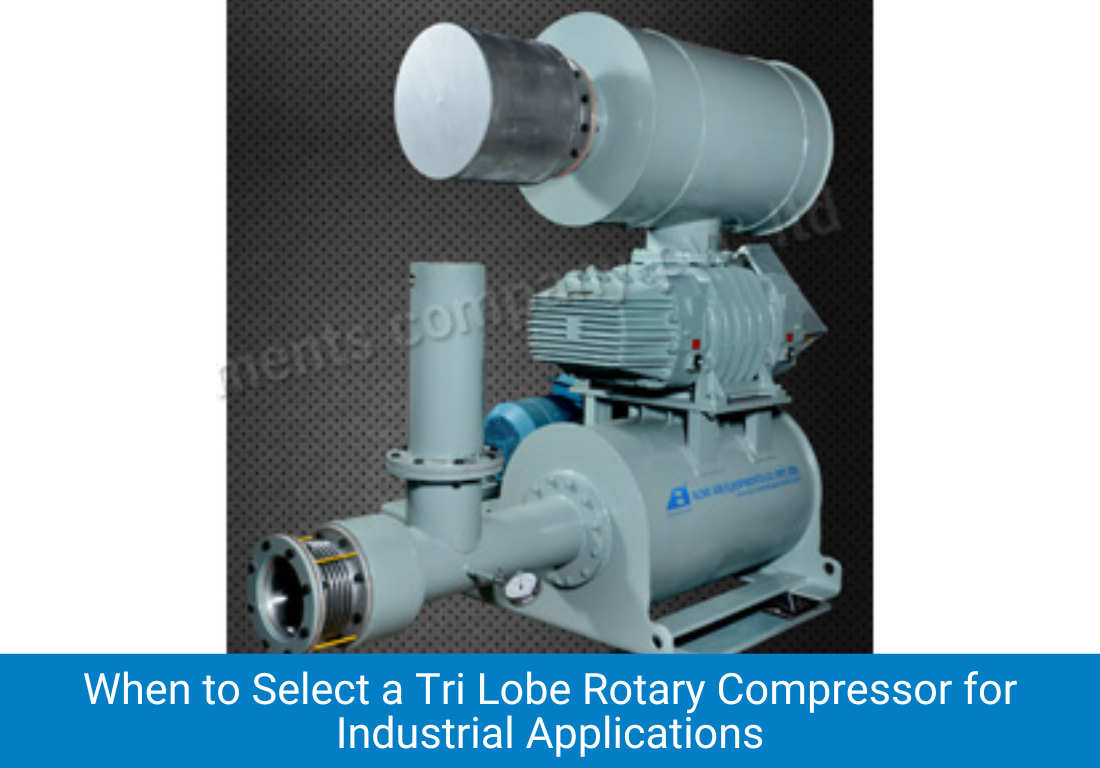
A tri lobe rotary compressor uses rotors with three lobes each instead of two. The three lobe profile is precisely calculated to maintain the same positive displacement characteristic while sweeping 6 air volumes per revolution rather than 4. At 1,500 RPM, the discharge pulsation frequency is 6 multiplied by 1,500, giving 150 Hertz, which is a higher frequency but lower amplitude pulsation.
The tri lobe profile also allows the machine to run at higher rotational speeds for a given swept volume, because the shorter lobe length at each tip means lower tip velocity and lower stress on the timing gears. Acme Air Equipments designs its tri lobe rotary compressors to cover flow ranges from 1,000 to 18,000 cubic metres per hour at operating speeds up to 3,600 RPM.
The compact and smooth flow of the tri lobe design also reduces internal gas recirculation losses, which contributes to a slightly higher volumetric efficiency compared to a twin lobe machine of equivalent displacement.
Performance Comparison: Twin Lobe vs Tri Lobe
| Parameter | Twin Lobe Rotary Compressor | Tri Lobe Rotary Compressor |
|---|---|---|
| Volume sweeps per revolution | 4 | 6 |
| Pulsation frequency at 1500 RPM | 100 Hz | 150 Hz |
| Pulsation amplitude | Higher | Lower |
| Noise level (dB) at equivalent duty | Higher by 3 to 6 dB | Lower |
| Maximum operating speed | Lower | Higher |
| Volumetric efficiency | 88 to 92% | 90 to 95% |
| Footprint at equivalent capacity | Larger | Smaller and more compact |
| Flow uniformity | Moderate | Better |
| Capital cost | Lower | Slightly higher |
| Best pressure range | 0.1 to 1.0 bar g | 0.1 to 3.0 bar g |
When Should You Choose a Twin Lobe Rotary Compressor?
A twin lobe design remains the preferred choice in several specific situations:
- **Very low speed, high pressure applications** where the longer stroke of the twin lobe geometry provides better pressure differential capacity at lower rotational speeds. For applications above 1.5 bar at flow rates below 500 cubic metres per hour, twin lobe machines offer reliable performance at competitive cost
- **Simple, low cost installations** in applications that are not sensitive to noise or flow pulsation, such as simple powder conveying systems in rural or industrial locations far from residential areas
- **Vacuum applications** at moderate vacuum levels below 0.5 bar absolute, where the twin lobe design has a well established track record and spare parts availability is important
- **Retrofit replacements** for existing twin lobe installations where the pipework, foundation, and motor drive are all designed around the twin lobe frame dimensions
When Should You Choose a Tri Lobe Rotary Compressor?
The tri lobe design is the better choice in the majority of modern industrial applications, particularly where continuous duty, energy efficiency, and noise level matter:
- **Wastewater aeration** in sewage treatment and effluent treatment plants, where the lower noise of the tri lobe machine is highly valued in urban locations and the higher efficiency reduces the dominant electricity cost
- **Pneumatic conveying of cement, fly ash, and bulk minerals** where the higher throughput capacity per frame size reduces installation footprint and the smoother flow improves conveying stability
- **Mechanical Vapour Recompression (MVR)** in sugar mills and evaporation plants, where flow uniformity directly affects the thermal performance of the evaporator and the tri lobe’s smooth delivery is a significant advantage
- **Biogas compression** where the lower tip speed of the tri lobe design at equivalent flow reduces mechanical stress in the hazardous gas environment
- **Any 24 hour continuous duty application** where the higher volumetric efficiency of the tri lobe machine reduces long term electricity costs relative to the modest additional capital cost
Industry Applications: Which Design Is Standard?
| Industry or Application | Recommended Design | Key Reason |
|---|---|---|
| Wastewater aeration (STP/ETP) | Tri lobe | Lower noise, higher efficiency for 24/7 duty |
| Cement conveying, fly ash handling | Tri lobe | High capacity, smooth flow, compact footprint |
| MVR in sugar and evaporation plants | Tri lobe | Flow uniformity critical for thermal efficiency |
| Biogas compression and upgrading | Tri lobe | Lower speed, lower heat at equivalent duty |
| Small workshop dilute phase conveying | Twin lobe | Cost effective for intermittent duty |
| Vacuum applications below 0.5 bar abs | Either design | Both perform well; twin lobe often preferred for cost |
| High pressure dense phase (above 2 bar) | Rotary compressor or screw | Both lobe types have limits above 3 bar |
Frequently Asked Questions
What is the difference between a roots blower and a rotary compressor?
The terms roots blower and rotary compressor both refer to the same type of positive displacement machine that uses two or three lobed rotors in a close tolerance casing. Roots blower is the historical trade name used in India and widely adopted for machines operating at lower pressures, typically below 1 bar gauge. Rotary compressor or lobe compressor is the technically accurate engineering term. Acme Air Equipments uses both terms depending on the application context.
Why does a tri lobe rotary compressor run quieter than a twin lobe at the same flow?
The lower noise of a tri lobe machine arises from two factors. First, the higher pulsation frequency of 150 Hz versus 100 Hz at 1,500 RPM means the pressure waves are shorter and easier to attenuate in a standard silencer. Second, the tri lobe rotor sweeps smaller individual air volumes at higher frequency, which means each discharge event is smaller in amplitude even though they occur more often. The combination of higher frequency and lower amplitude produces less acoustic energy at the frequencies humans find most disturbing.
Can a twin lobe compressor be replaced with a tri lobe unit on an existing installation?
In most cases yes, but the replacement requires attention to shaft height and drive connection geometry, as tri lobe and twin lobe machines of equivalent capacity have different frame dimensions. Flange port sizes are typically standard in both designs, so pipework connections can usually be adapted. Acme's engineering team can advise on the specific compatibility for a given installation.
About Author

CEO
Mr. Vishwesh Pardeshi is the CEO of Acme Air Equipments Company Pvt. Ltd., an industrial and engineering goods manufacturing company based in Ahmedabad, Gujarat (India). He has taken over the responsibility from founding Partners and Directors of the Company, and is now leading a talented group of professionals since 2020 by bringing in vast industrial and management expertise. By qualification, he holds a Bachelor Degree in Mechanical Engineering and also holds a MBA degree from reputed institutes. Under his leadership, the Company has successfully executed prestigious projects by delivering high quality and world class products from a state of the art manufacturing facility which combines CNC-enabled precision manufacturing and strong after sales support. In line with the Vision, Mission and Core Values of the Organization, Mr. Vishwesh Pardeshi continues to drive Quality, Reliability and Global Expansion at Acme Air Equipments Co. Pvt. Ltd.