






Table of Contents
What Is Dilute Phase Pneumatic Conveying and How Does It Work?
Dilute phase pneumatic conveying, also known as lean phase conveying, is the most widely used form of pneumatic material transport. The system uses a high velocity air stream, typically between 18 and 35 metres per second, to suspend individual particles and carry them through the pipeline in a state of continuous suspension. Because each particle is kept airborne throughout the journey, the material to air ratio is low, generally between 1 and 15 kilograms of material per kilogram of air.
The system operates at relatively low pressure, typically 0.1 to 0.8 bar gauge on the pressure side, or at vacuum levels of 0.3 to 0.8 bar absolute when configured as a vacuum conveying system. A roots blower or rotary compressor provides the motive air, and a bag filter or cyclone separator recovers the material at the destination.
Dilute phase systems are straightforward to design and relatively low in capital cost. They work extremely well for free flowing granular materials, plastic pellets, ground minerals, grain, and any product that is not fragile, not highly abrasive, and does not absorb moisture readily.

What Is Dense Phase Pneumatic Conveying and How Does It Work?
Dense phase pneumatic conveying moves material through the pipeline in a fundamentally different manner. Rather than suspending particles in a fast air stream, the system pushes material in compact slugs or a moving bed at high pressure and very low velocity, typically between 1 and 10 metres per second. The material to air ratio is correspondingly high, between 30 and 150 kilograms of material per kilogram of air, and the operating pressure at the inlet is typically between 1.5 and 5 bar gauge.
There are two common modes within dense phase conveying: plug flow, where discrete slugs of material are pushed through the pipe separated by air gaps, and fluidised moving bed, where material flows continuously in a densely packed layer along the bottom of the pipeline. Both modes achieve the same fundamental objective of moving material gently at low velocity.
Because velocity is low, particle degradation is minimal. Friable tablets, whole spices, coffee beans, sugar crystals, activated carbon pellets, and abrasive powders such as alumina or silicon carbide can all be conveyed in dense phase mode without the breakage, attrition, or surface damage that high velocity dilute phase conveying would cause.
Side by Side Comparison: Dense Phase vs Dilute Phase Conveying
| Parameter | Dilute Phase (Lean Phase) | Dense Phase |
|---|---|---|
| Air velocity | 18 to 35 m/s | 1 to 10 m/s |
| Operating pressure | 0.1 to 0.8 bar g | 1.5 to 5.0 bar g |
| Material to air ratio | 1 to 15 kg/kg | 30 to 150 kg/kg |
| Air consumption | High | Low |
| Particle degradation risk | Moderate to high | Very low |
| Pipeline and bend wear | Higher | Lower |
| Capital cost | Lower | Higher |
| Suitable materials | Free flowing, robust granules | Fragile, abrasive, hygroscopic powders |
| Typical pipe sizes | Smaller bore at lower capacity | Larger bore, shorter distances |
| Motive air source | Roots blower, rotary compressor | High pressure rotary compressor or screw compressor |
Read Our Article
Mechanical Vacuum Boosters: Revolutionizing Re-Used Oil Distillation
Which Industries Use Dilute Phase Pneumatic Conveying Systems?
Dilute phase or lean phase pneumatic conveying systems are standard in applications where the material can withstand the velocity without damage and where volume throughput is more important than gentle handling. Key industries and applications include:
- **Cement and fly ash handling** in ready mix plants, silos, and power stations where high tonnage throughput is required over moderate distances
- **Plastic pellet conveying** in injection moulding, extrusion, and film blowing plants where pellets are robust and free flowing
- **Grain and seed transfer** in flour mills, feed mills, and grain storage where whole grains are conveyed between silos and processing equipment
- **Sand and mineral powder conveying** in foundries, glass plants, and ceramic manufacturers for raw material supply
- **PVC powder and resin conveying** in pipe extrusion and compound manufacturing where coarse powders flow freely
Which Industries Use Dense Phase Pneumatic Conveying Systems?
Dense phase systems are the preferred pneumatic conveying solution for high value or structurally sensitive materials where product integrity directly affects quality or regulatory compliance. Key industries include:
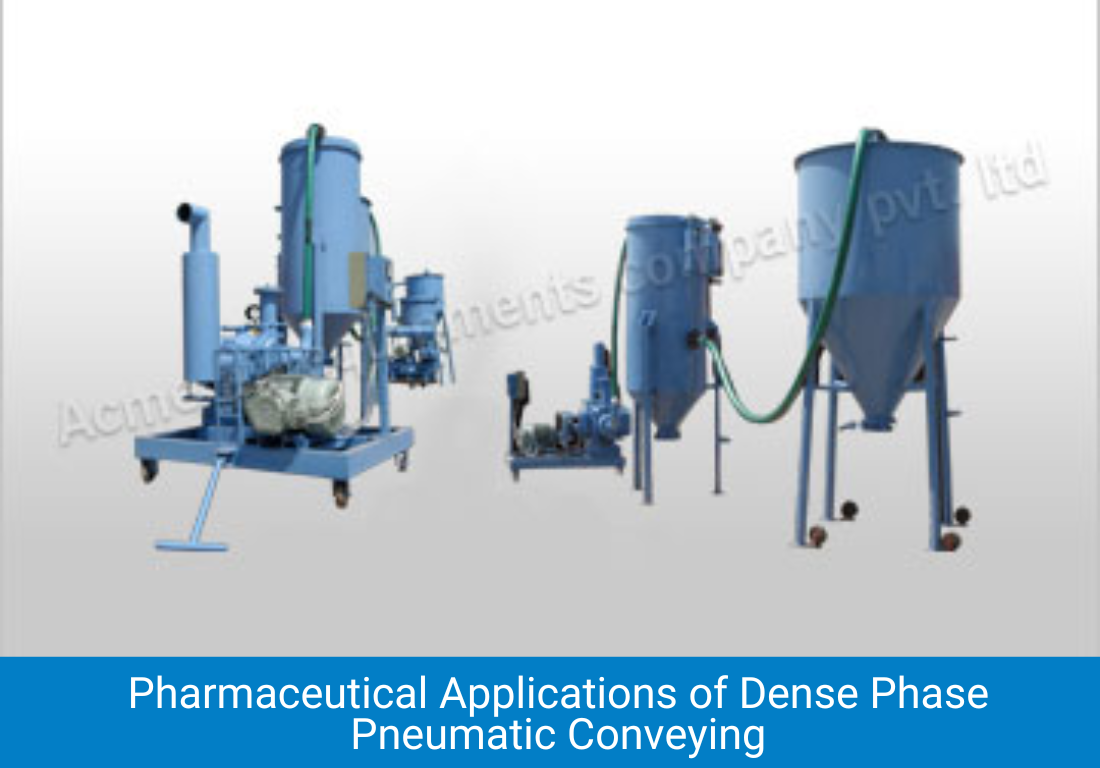
- **Pharmaceutical manufacturing** where active pharmaceutical ingredients, excipient powders, and granules must be transferred without attrition that could affect dissolution rate, particle size distribution, or blend uniformity
- **Food processing** where whole spices, dried fruit, coffee beans, nuts, and fragile pasta shapes need to arrive at the destination unchanged in size and appearance
- **Chemical plants** where abrasive powders such as titanium dioxide, alumina, and soda ash would rapidly erode a dilute phase pipeline
- **Carbon black and pigment conveying** where particle size distribution is critical and contamination from pipeline wear must be avoided
- **Specialty polymers and engineering plastics** where pellet surface finish and dimensional accuracy affect downstream processing
Our Other Product
How Does Operating Humidity and Temperature Affect System Selection?
Hygroscopic materials, which readily absorb moisture from air, present a particular challenge in dilute phase systems because the high volume of moving air carries more moisture into contact with the product. In dense phase systems, the low air to material ratio dramatically reduces moisture exposure. Hygroscopic powders such as sodium carbonate, certain pharmaceutical excipients, and sugar in fine form are therefore almost always conveyed in dense phase mode.
Temperature is also relevant. In high temperature applications above 80 degrees Celsius, the air delivery equipment and pipeline insulation requirements differ significantly between the two modes. Dense phase systems generally handle hot conditions more easily because the lower air volumes generate less thermal stress on seals and filter media.
What Air Supply Equipment Does Each Mode Require?
For dilute phase systems, a roots blower or twin lobe rotary compressor delivering 0.3 to 0.8 bar gauge is the standard motive air source. Acme Air Equipments supplies twin lobe and tri lobe roots blowers across a flow range from 100 to 18,000 cubic metres per hour, covering the full range of dilute phase conveying applications from small workshop systems to large cement plant installations.
For dense phase systems, a high pressure rotary compressor delivering 2 to 5 bar gauge is required. Screw compressors or reciprocating compressors are used at the higher end of the pressure range, while Acme’s tri lobe rotary compressors cover the 1.5 to 3 bar range for medium pressure dense phase applications. In both cases, an air receiver and pressure regulation system are essential to maintain stable conveying conditions.
Frequently Asked Questions
Pneumatic Conveying System: Which One Does Your Industry Need?
What is the difference between dense phase and dilute phase pneumatic conveying?
Dilute phase conveying carries material suspended in a high velocity air stream at low pressure. Dense phase conveying pushes material in concentrated slow moving slugs at high pressure and low velocity. Dense phase is gentler on fragile or abrasive materials. Dilute phase is more economical for robust free flowing bulk solids.
Which pneumatic conveying system is better for pharmaceutical powders?
Dense phase pneumatic conveying is strongly preferred for pharmaceutical materials because the low air velocity prevents particle attrition, avoids segregation of blended powders, and minimises the air contact that could affect hygroscopic ingredients. Dilute phase would degrade many API and excipient particles.
Can a roots blower power both dense phase and dilute phase conveying systems?
A roots blower or twin lobe rotary compressor is well suited for dilute phase conveying, operating at 0.3 to 0.8 bar gauge. Dense phase conveying typically requires higher pressures of 2 to 5 bar, which is beyond the range of a standard roots blower. For dense phase systems, a tri lobe rotary compressor or screw compressor at the appropriate pressure rating is required.
What are lean phase and dilute phase? Are they the same?
Yes. Lean phase conveying and dilute phase conveying refer to the same mode of operation, where material is transported in low concentration at high velocity. The term lean phase is used more commonly in India while dilute phase is the internationally preferred technical term. Both describe pneumatic conveying systems with a low material to air ratio operating at velocities above 18 m per second.
What is the typical pipe size for a dense phase pneumatic conveying system?
Dense phase systems typically use larger bore pipelines than dilute phase systems handling the same throughput, because the lower velocity requires a higher material cross sectional area in the pipe. For typical industrial throughputs of 5 to 50 tonnes per hour, pipe diameters of 80 to 200 millimetres are common. The exact size depends on material bulk density, conveying distance, and pressure drop calculations, which Acme's engineers calculate for each project.
CEO
Mr. Vishwesh Pardeshi is the CEO of Acme Air Equipments Company Pvt. Ltd., an industrial and engineering goods manufacturing company based in Ahmedabad, Gujarat (India). He has taken over the responsibility from founding Partners and Directors of the Company, and is now leading a talented group of professionals since 2020 by bringing in vast industrial and management expertise. By qualification, he holds a Bachelor Degree in Mechanical Engineering and also holds a MBA degree from reputed institutes. Under his leadership, the Company has successfully executed prestigious projects by delivering high quality and world class products from a state of the art manufacturing facility which combines CNC-enabled precision manufacturing and strong after sales support. In line with the Vision, Mission and Core Values of the Organization, Mr. Vishwesh Pardeshi continues to drive Quality, Reliability and Global Expansion at Acme Air Equipments Co. Pvt. Ltd.